The Illuminating Art of Egg Tempera
How Scottish painter Colin Fraser revived this ancient art
- Text by J.H. White
- Paintings by Colin Fraser
“Critics and curators want to educate people, but art is not about educating people, it’s about touching them at an emotional level.”
—Colin Fraser
Acclaimed Scottish egg tempera painter Colin Fraser moved to his Swedish home by the sea many years ago, but it was only recently that he decided to paint it.
“However beautiful something is; it has to mean something to me,” Fraser says.

When looking at the finished painting, he realized that he had represented himself in the landscape—his journey of moving to Sweden, getting married, and making his home there.
“Those feelings were in that landscape, and it clearly came across to people,” Fraser says.
One morning, a local couple noticed his painting at the art gallery where it was being exhibited.
“They were standing in front of the landscape, both in tears. They just told me what this place had meant to them,” Fraser says. The couple then bought the painting.
An endless moment
Fraser fondly remembers the first time he was struck by the beauty of a painting. He was at the National Museum in Amsterdam and saw Vermeer’s work The Milkmaid.

“It hung on a wall more or less on its own for the simple reason that you couldn’t hang anything else anywhere near it. It blew everything else away. It was just incredible,” Fraser says.
Fraser says that Vermeer’s contemporaries, who painted in a similar style and genre, were churning out technical works, focusing on surface beauty and accuracy.
“Vermeer’s painting took it to a completely different level of expression, grace, and beauty by using paint differently,” he says.
These days, Fraser feels that contemporary trends are steering people down a limited road of artistic expression.
On the one hand, there are those who believe that art should provoke a jarring intellectual response in people. “Critics and curators want to educate people, but art is not about educating people,” he says. “It’s about touching them at an emotional level.”
On the other hand are artists who produce photorealistic paintings that pursue superficial accuracy but lack meaning. “The problem is that there’s no life in it. They’re so concerned with the process that the painting is stone-dead. There’s no expression,” Fraser says.
His paintings, however, don’t try to be photographic snapshots of a fleeting moment. Instead, they lock the viewer in a moment that never ends.
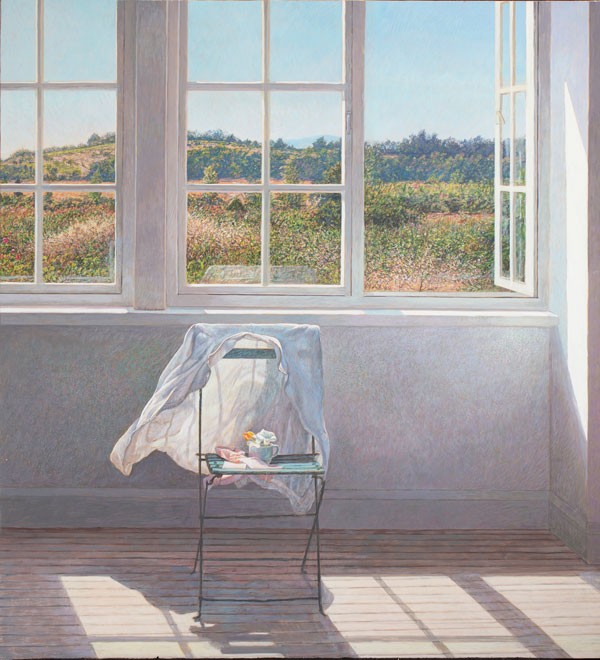
It’s easy to see this in Fraser’s painting, Westerly. The wind gives life to the shirt blowing on the chair; you can feel the sun’s warmth and feel the breeze on your skin. A hint of loneliness or longing freezes you and keeps you where you are. The experience only stops when you look away.
“The whole point of art is that it’s not concrete. It touches people in one way or another on an emotional level,” Fraser says.
A tough egg to crack
In the early 80s, Fraser worked extensively in oils and watercolour and had showings at the Royal Watercolour Society in London and the Royal Academy summer exhibition. But he found watercolour to be very limited in its expression. After three washes—or layers of paint—the colours lost their freshness.
“I just needed something that gave me more depth,” Fraser says.
He then read that the most difficult technique to work in was egg tempera, which dated back to ancient Egypt. Without any contemporary literature on the medium, Fraser dove in and taught himself. Since no one used the technique anymore, he couldn’t go to a store and buy the materials. He had to make them all himself.

For egg tempera, the artist paints on gesso ground, a mixture of chalk, white pigment, and rabbit-skin glue cooked to specific temperatures. The gesso is applied in multiple layers to the ground—the surface the artist paints on—which is then sanded down to a very smooth surface.
“It’s a very labourious technique,” Fraser says.
The binding, or what glues the paint pigment to the surface, is egg yolk, a delicate organic, semi-transparent substance. Due to its see-through nature, artists can’t hide their mistakes. This is different from oil painting, where artists can keep painting over something until they get their desired result. However, the egg yolk’s translucence gives it a spark of life, unlike any other medium.
“Rays of light hit the surface of the painting, penetrate it, and bounce back off the gesso ground. That egg gives you a very brilliant surface to work on, but it also brings a glass-like smooth quality to the surface as well,” Fraser says.

“The payback is this incredible luminosity. You can’t compare it to a watercolour or an oil painting. It’s like looking at a picture on a computer screen that’s lit from behind.”
The second major difficulty of this technique is how quickly the egg tempera paint dries. It took Fraser ten years to master its basics.
But his breakthrough with egg tempera was as much philosophical as it was technical. With oil, artists can work with wet paint, move it around the canvas, or layer over anything they don’t like. With egg tempera, they need to have a clear idea of what they’ll do since the tempera dries fast, and they can’t hide anything.
“That creates a paradox of which way to go,” Fraser says.

The approach that Fraser has adopted is almost sage-like. He stays present during the creation process and lets the painting take on a life of its own. By giving up control, he can control it, or at least become a channel for a piece of art that’s full of spirit and meaning.
“True beauty isn’t perfect. It has to have imperfections. When you’re making a painting, it has to be alive first and foremost,” Fraser says.
“I realized that the only way that I was going to be able to do something meaningful with tempera was to find acceptance of who I am and what I paint instead of trying to change.”
Perhaps that’s why viewers are so touched by his paintings.
Inspired for a Beautiful Life
Related Articles
Mesmerizing Memory Paper: A Pioneering Art Form
Japanese artist Tetsuya Nagata’s paper art, while novel, is deeply rooted in centuries of tradition.
Shen Yun Dancer Lives Her Beliefs
Behind the scenes with Shen Yun dancer, Teresa Du, where simplicity and traditional Chinese values foster teamwork.