
Across the vast expanse of human history, line art has endured as an elemental form of artistic expression. From the ancient Chinese characters found on oracle bones (dating to approx. 1400 B.C.) to the animals and human figures created some 15,000 years ago in the Altamira Caves, Spain, our ancestors have consistently harnessed the power of lines to share their creative visions.
Line art, as defined in the West, is an artistic form that relies solely on the use of lines, without any form of gradation or shading. In ancient China, however, lines, often used with shading or color, were considered not just elements of composition, but the very soul of a painting.
Available in an endless variety to delineate boldness, length, smoothness, and straightness, lines can illustrate a profound complexity that transcends their seemingly straightforward nature. It’s truly awe-inspiring how much a painter can express through the manipulation of simple lines.
In this article, we’ll explore 10 line art paintings, both ancient and contemporary, that offer us a captivating glimpse into the rich heritage and artistic finesse of this unique form of art.
1.

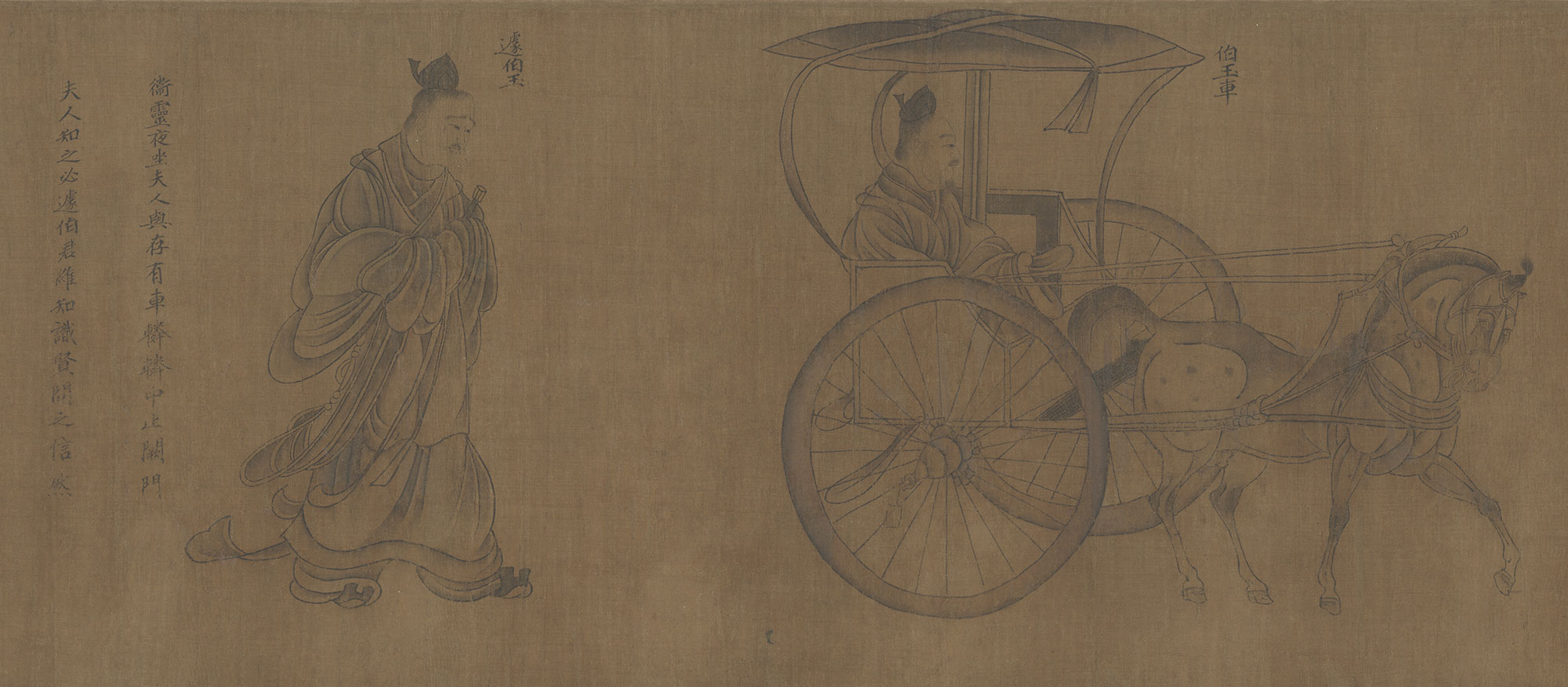
Title: Wise and Benevolent Women, 13th-century Song Dynasty (960–1279), copy 顾恺之列女仁智图卷(宋摹)
Painter: original work from Gu Kaizhi (c. 344 – 406))
Provenance: Palace Museum, Beijing
Medium: ink on silk
Size: 25.8 h x 417.8 w cm
This masterpiece was created by Gu Kaizhi (born circa 344 A.D.), who is revered as the founder of traditional Chinese painting. Renowned for perspectives such as “transmitting thoughts with subtlety” (迁想妙得) and “capturing the spirit through form” (以形寫神), Gu played a pivotal role in shaping the development of Chinese paintings.
Gu was recognized in his lifetime for painting with delicate, gossamer-like ink outlines—a pioneering technique at the time. The lines in his paintings resemble endless silk threads, which are not only intricate and remarkably lifelike but also emanate extraordinary spirit and charm.
His four-meter silk scroll masterpiece titled Wise and Benevolent Women features sixteen characters grouped as part of seven stories from history. Through Gu’s brush, the expressions, temperaments, and identities of the figures are vividly portrayed.
The painting is viewed from right to left. The characters in each storyline are grouped in either pairs or groups of three, and their expressions and emotions are conveyed with exceptional artistry.
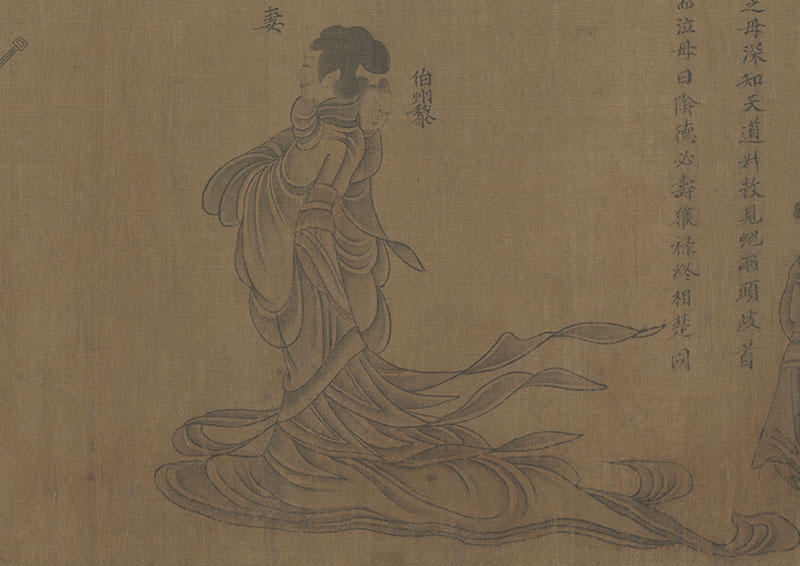
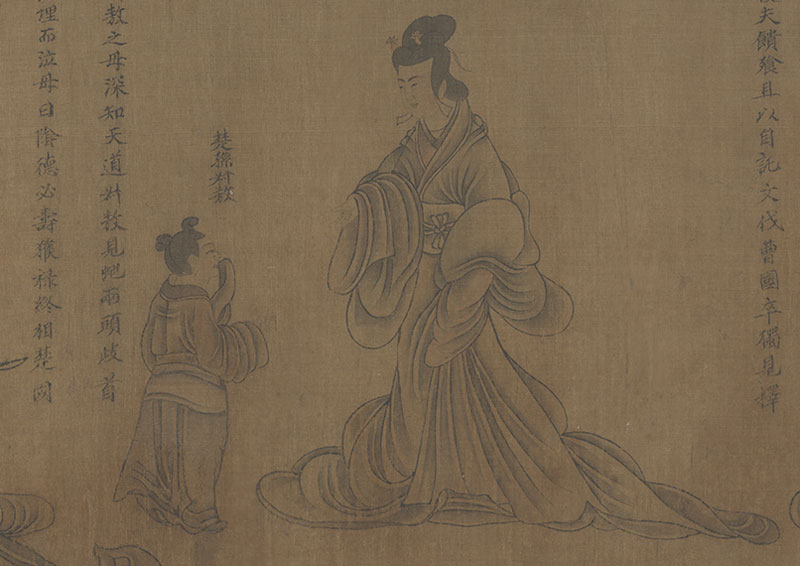
The clothes worn by the figures are eye-catching and awe-inspiring. The artist has depicted the soft, overlapping folds entirely through intricate lines, and merely observing the layers of interwoven textures and the flowing rhythm of the clothing can evoke great admiration in the viewer.
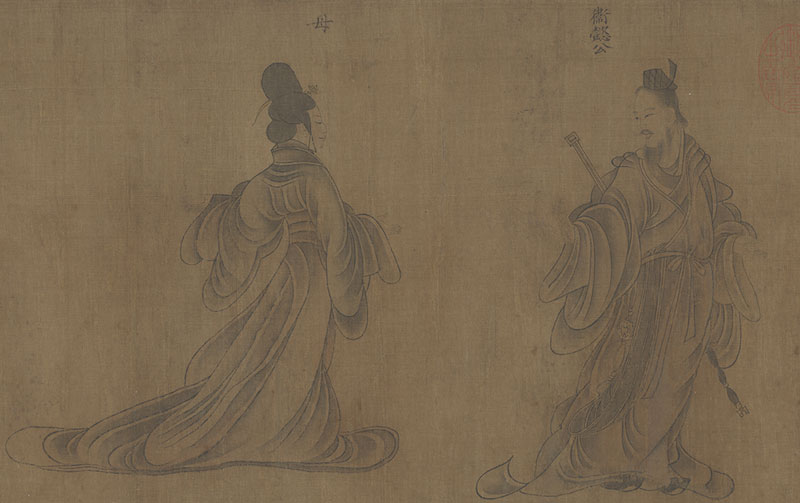
Gu’s depiction of the folds in the figures’ robes is not a faithful representation of how fabric is manipulated in reality. Instead, the artist used a varied assortment of meticulous lines to slightly exaggerate the clothing and highlight the contours of the human body. This orderly arrangement of clustered lines naturally forms a coherent and purposeful overall structure.
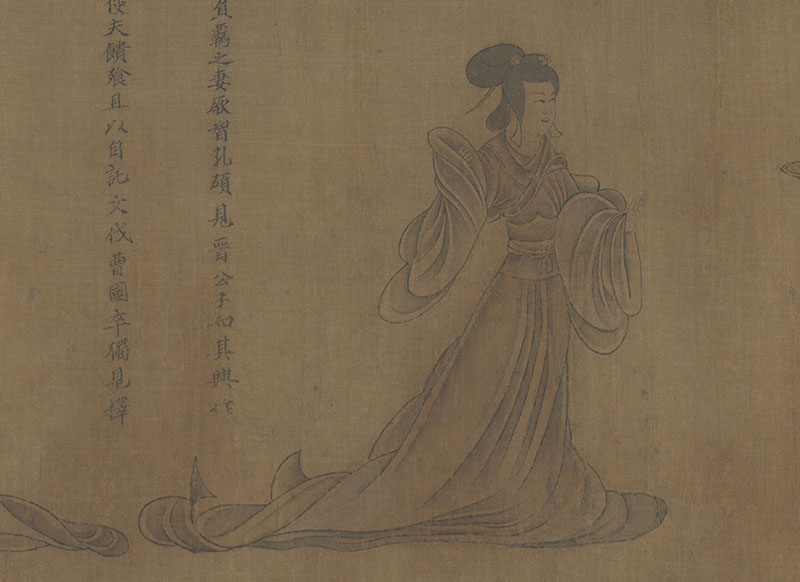
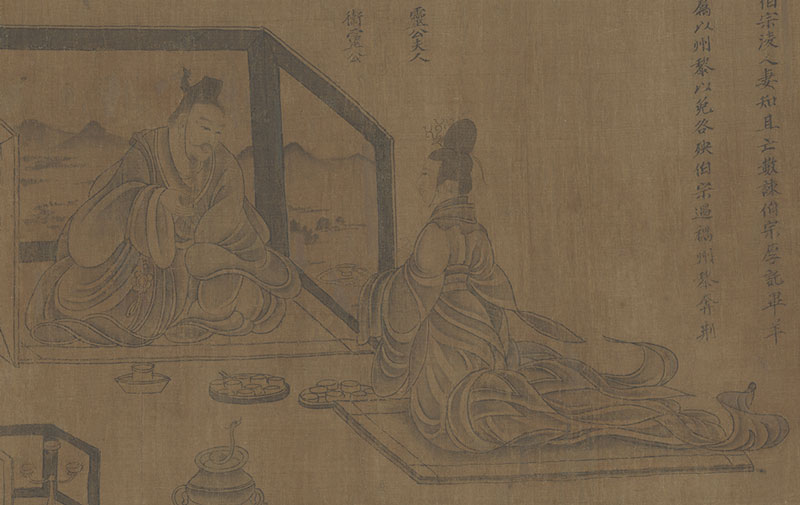
To convey a slender appearance, the “bones” play a crucial role. “Bones” refer to both the skeletal structure and the fundamental representation of body joints, revealed directly in the transitions of detailed clothing folds. In the painting, you can perceive the graceful waists of female figures, accompanied by the flowing sensation of clothing folds, both of which exude an aura of elegance.
At the same time, the flowing, cloud-like appearance of the robes allows the figures to look both earthly and otherworldly. Perhaps in Gu’s heart, these paragons of womanhood deserve not only to be immortalized through his superb artistry but also through attires that suggest perfection.
2.

Title: One Hundred Grandmasters免冑圖, Northern Song Dynasty
Painter: 李公麟 Li Gonglin (1041–1106)
Provenance: National Palace Museum, Taiwan
Medium: ink on Xuan paper
Size: 32.3H x 223.8W cm
Li Gonglin (1041–1106) was renowned for his mastery of the technique of baimiao (白描), or “plain drawing,” a term that originated in the Tang Dynasty (618–907) to denote monochrome line drawing without the use of shading. Before Li’s time, painting primarily served a public purpose, either as decoration or for didactic intent. However, Li turned painting into a medium for self-expression, elevating its status to parallel that of music, poetry, and calligraphy.
Li’s revolutionary style marked the establishment of three crucial elements in scholar-painting: a moral purpose, learned stylistic references to the past, and expressive calligraphic brushwork. During the Northern Song Dynasty (960–1127), Chinese scholar-artists believed that painting was more than a mere record of sensory experiences, but rather a reflection of the artist’s mind, personality, and moral values. By embodying this ideal, Li brought about a fundamental transformation in Chinese art.
Let us take a look at his masterpiece One Hundred Grandmasters, a piece praised by Emperor Qianlong (1711–1799) as “standing out as the foremost example of Li’s artistry in line drawing, particularly in the depiction of figures.”
The painting depicts Tang Dynasty general Guo Ziyi and his meeting with a Uyghur chieftain. Following the orders of the imperial court, Guo marched against the invading Uyghur army despite being hopelessly outnumbered. Yet his reputation as a military general of great prowess preceded him, and the Uyghur chieftain requested a meeting with Guo.
As seen in the painting, Guo didn’t wear his armor when he met with the chieftain. The latter, in turn, is shown bowing in a display of respect for Guo’s bravery and his loyalty to the Tang Dynasty.
This stunning line art employs the meticulous technique of ink lines to portray a scene that takes place within a vast military encampment. It showcases the refined and subtle elegance characteristic of literati painting amid the grandeur of a military setting. Such a marvelous piece of work is truly exceptional and rare.
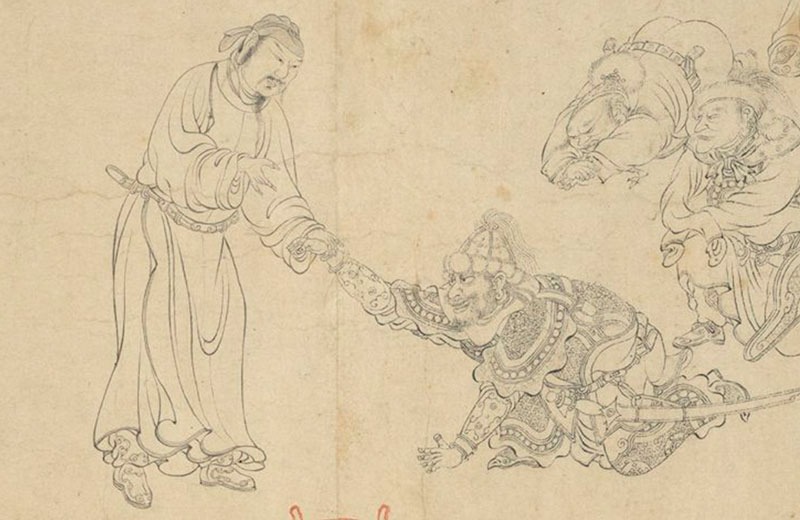
In this painting, the Uyghur chieftain, meticulously rendered with fine ink lines, dismounts to pay homage to Guo. The latter, clad in simple attire and unarmed, exudes a graceful demeanor, while also demonstrating a fearless spirit, as captured through Li’s precise and vivid use of delicate strokes.
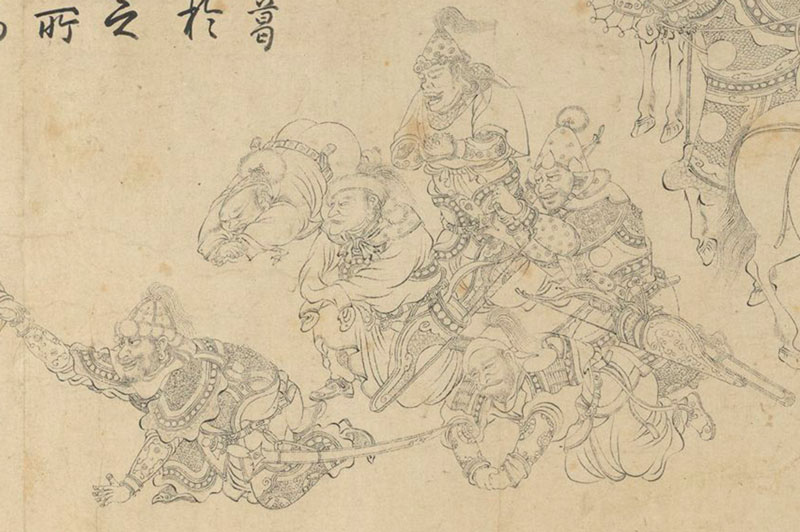
Through detailed ink lines, Li captured the details of the Uyghurs’ attire and their expressive facial expressions. Here, we can see that the Uyghur chieftain, followed by his subordinates, have dismounted and are prostrating themselves before Guo.
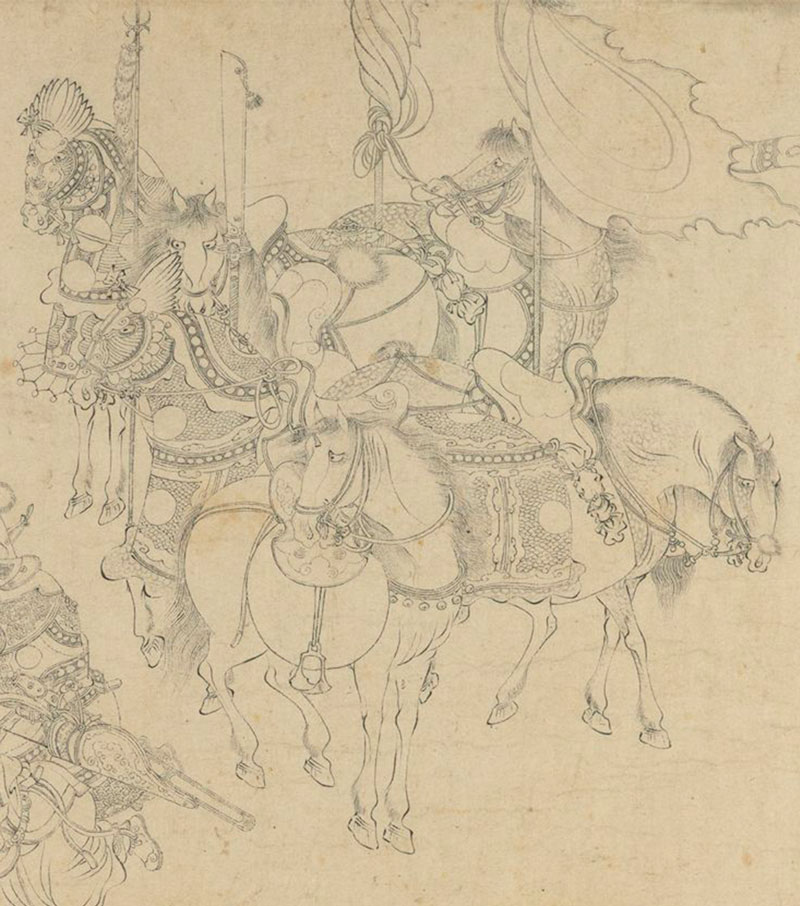
Behind the Uyghurs are six exquisitely adorned horses. Although this portrayal relies solely on line drawing and forgoes shading, it conveys a vivid sense of three-dimensionality.
When there’s a need to highlight certain elements with darker tones, Li uses condensed arrangements of points, lines, and surfaces. This technique beautifully captures the intricate details of war robes, headgear, armor, delicate reins, saddles, weapons, flags, and more, while also creating a deep-toned ambiance that accentuates the structure and forms of each component.
3.
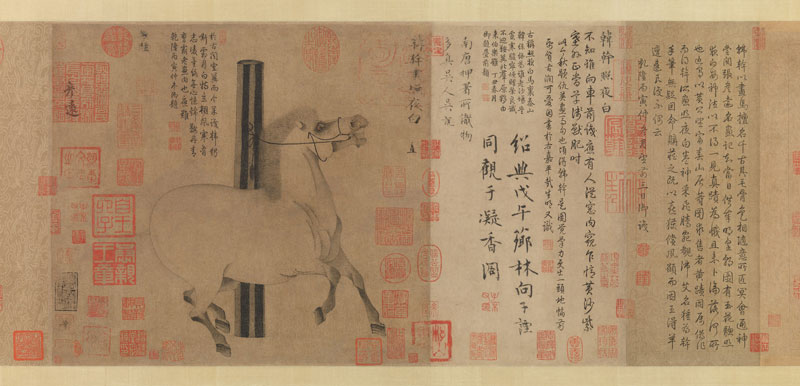
Title: Night-Shining White, ca. 750, Tang Dynasty (618–907)
唐 韓幹 照夜白圖 卷
Painter: Han Gan (Chinese, active ca. 742–756)
Provenance: Metropolitan Museum of Art, New York
Medium: ink on Xuan paper
Size: 30.8 h x 34 w cm
Tang Dynasty painter Han Gan (706-783) was acclaimed for his ability to not only capture the likeness of a horse but also its spirit. Night-Shining White, his most famous painting, is a portrait of one of Emperor Xuanzong’s beloved horses. By employing simple yet smooth and powerful lines, Han was able to expertly bring the animal to life.
Art imitates life, and that’s why Han visited the imperial stables to observe the appearances and behaviors of the animals. His precise rendering of this horse is a testament to his acute observation skills.
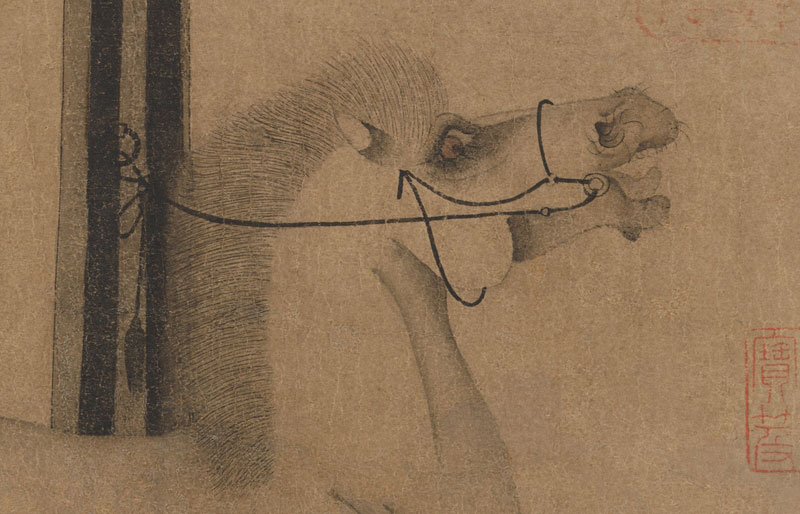
Han ingeniously uses a single line to capture the muscles in the horse’s straining neck. The mane is painted with intricately fine lines, and the hairs stand erect in this painting to further emphasize the horse’s frightened expression.
These lines, alongside the remarkably painted eye and curved tongue in the horse’s gaping mouth, bring the painting to life. The viewer can see the wildly rolling eye and almost hear the bold whiny of a steed worthy of the emperor of one of China’s most spectacular dynasties.
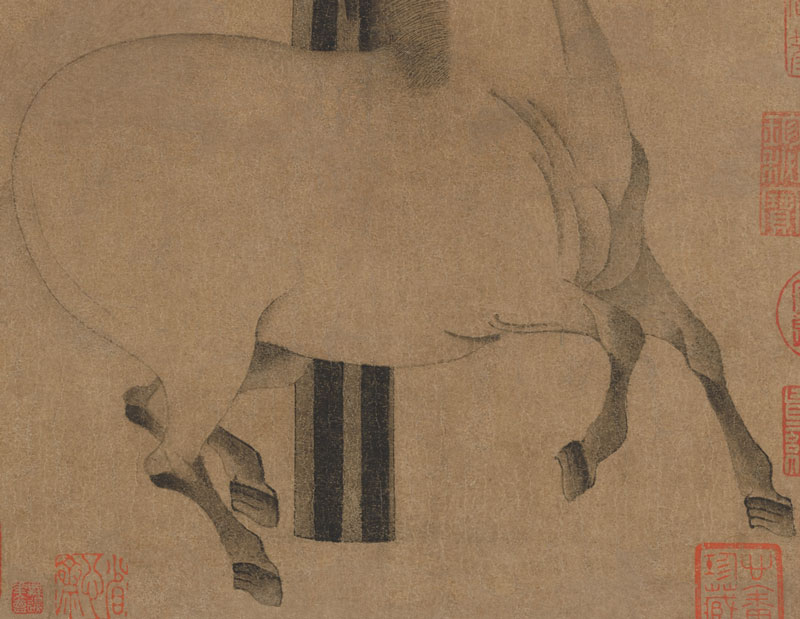
Han used clustered lines and certain shading techniques to paint the horse’s muscular torso, once again showcasing his talent for keen observation, alongside his exquisite artistry. The horse’s back and rump are drawn with a single thin clean line, yet curiously, the horse’s tail is missing, leading experts to suggest that it may have faded over time.
The red seals scattered across the painting and the inscription found on the scroll’s reverse side indicate the number of prominent collectors who have owned the painting between the Tang and Qing dynasties and are a testament to Han’s talent and influence.
Seals and inscriptions added to paintings by their owners are a distinctive feature of Chinese art connoisseurship. The seals allow future viewers to know who owned the painting, and the inscriptions can also communicate a wide range of information, such as what the owners admired about the painting, or how they acquired it.
Notable owners of this painting include Southern Tang emperor Li Yu (937–975), celebrated calligrapher Mi Fu (1051–1107), and the Qianlong Emperor (1711–1799).
4.

Title: The Peach Blossom Spring, Ming Dynasty (1368–1644)
桃花源圖卷 (仇英)
Painter: Qiu Ying (about 1494–1552)
Provenance: Museum of Fine Arts, Boston
Medium: ink and color on paper
Size: 33 h x 472 w cm
This painting is named after the literary work it was based on—The Peach Blossom Spring by Eastern Jin Dynasty poet Tao Yuanming (365–427), which describes a fisherman who unwittingly finds his way into a utopia where people live in harmony with each other and nature. The painting was previously believed to be by Ming Dynasty artist Qiu Ying (1494-1552), although scholars now believe that this particular copy was made by a copyist during the late Ming or early Qing Dynasty.
Peach blossoms in bloom can be found throughout the painting, both surrounding the village and peeking out among the mountains. In traditional Chinese culture, peaches are a symbol of immortality. The delicate pink of the peach blossoms offers a contrast to the blue and green of the mountains. Fine, intricate lines are used to shape and give texture to the lush, towering landscape.
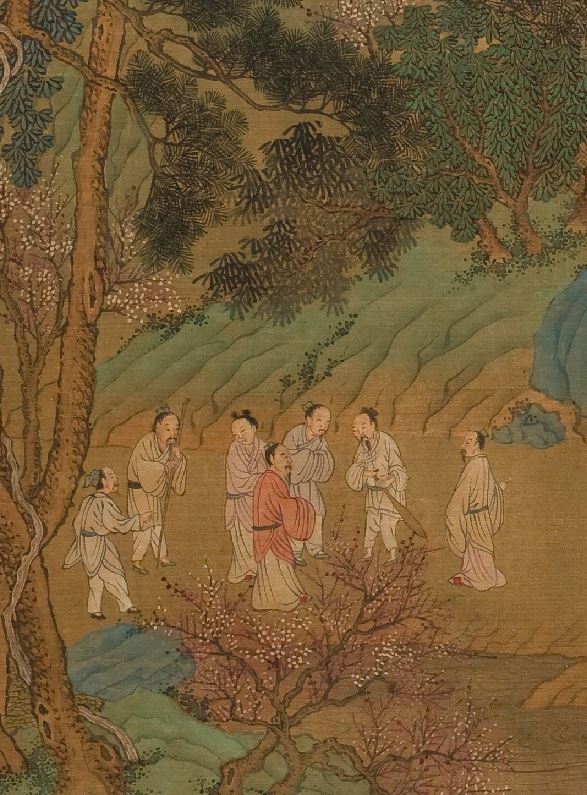
The details in this painting are truly remarkable, from the leaves and pine needles to the gently swirling clouds in the distance, from the tiled rooftops to the soft folds of the clothing. Each individual line comes together to form a complex scenery of tranquility and seclusion.
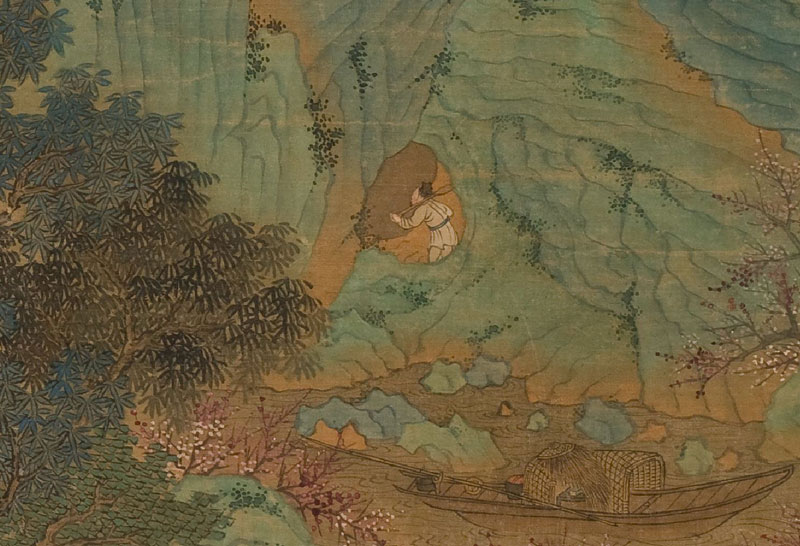
This scroll painting is meant to be viewed from right to left, and as the viewer moves down the scroll, the story of the Peach Blossom Spring unravels itself. Near the beginning of the scroll, one can see a cave entrance in the mountains, and in it, a small human figure—the protagonist in Tao Yuanming’s poem—tentatively observing the world he has stumbled upon.
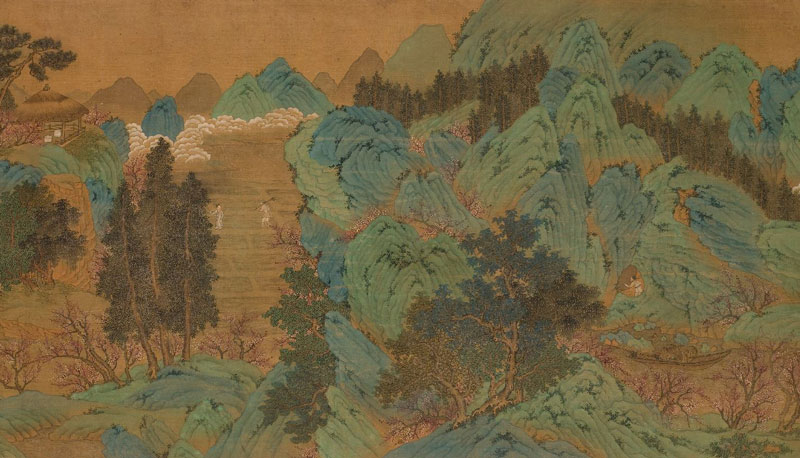
Further down is the village nestled in the vibrant mountains, where the villagers are depicted in a moment of leisure. They seem to lead simple lives; neither their homes nor clothing are of particular extravagance, yet the ethereal mountains they live in carry an aura of peace and tranquility.
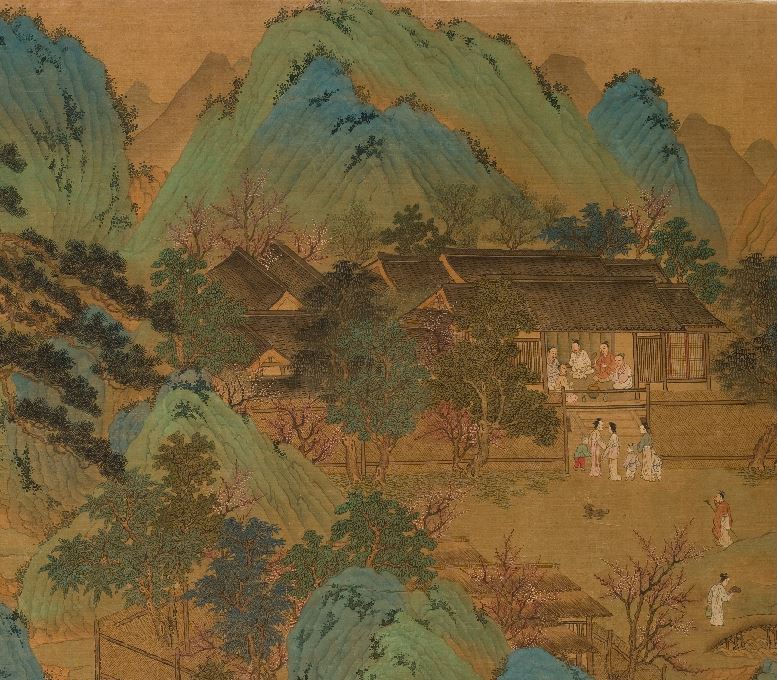
The human figures in the painting are entirely surrounded by the grand mountain landscape, and this is how the painter conveys the unity of humans with nature. Nature’s magnanimity and ability to nurture life are emphasized in the manner in which the houses are seamlessly integrated into the landscape, sheltered by the mountain’s embrace.
5.
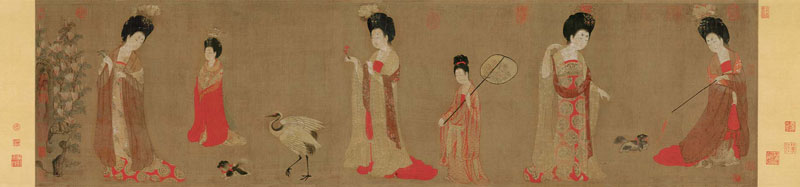
Title: Court Ladies Adorning Their Hair with Flowers, Tang Dynasty
Painter: Zhou Fang (active late 8th-early 9th century)
Provenance: Liaoning Provincial Museum
Medium: ink and color on silk
Size: 45.5h x 175.5w cm
Tang Dynasty painter Zhou Fang’s famous masterpiece, Court Ladies Adorning Their Hair with Flowers, is a glamorous display of the attire worn by the aristocratic ladies of the Tang imperial court.
The Tang Dynasty was a prosperous era, believed to have been China’s golden age. The painting, depicting five aristocratic women and a maid, is particularly eye-catching due to its superb rendering of the women’s clothing and the use of smooth continuous lines to paint the outline of their bodies.
Zhou’s impressive execution of different types of lines is not only a display of his artistry but also of his acute attention to detail.
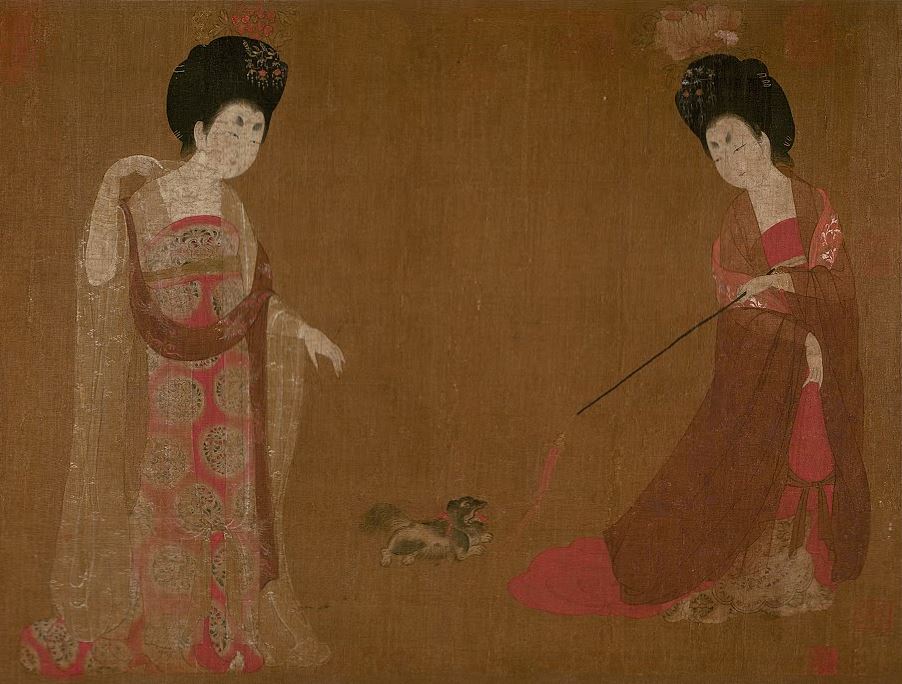
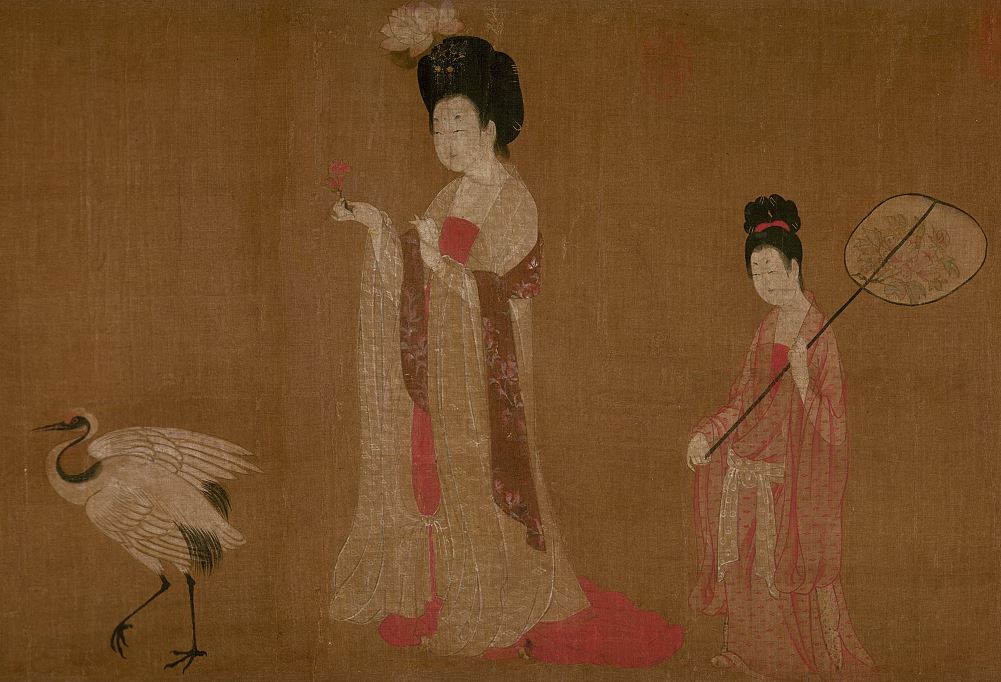
An intricately patterned gauze shawl was a central part of the Tang noblewomen’s attire, and we can see that all six women, even the maid, are wearing one. With a few simple lines and his gifted sense of color combination, Zhou captures the airiness and translucent quality of gauze and the way it shifts on the body with the wearers’ movements.
The second woman from the right has lifted a hand, so the gauze has slipped off her lifted forearm; the red gauze sleeve of the maid, who is holding a large fan and standing away from the noblewoman in the painting’s center, has bunched in the crook of her elbow due to the pose she is holding.
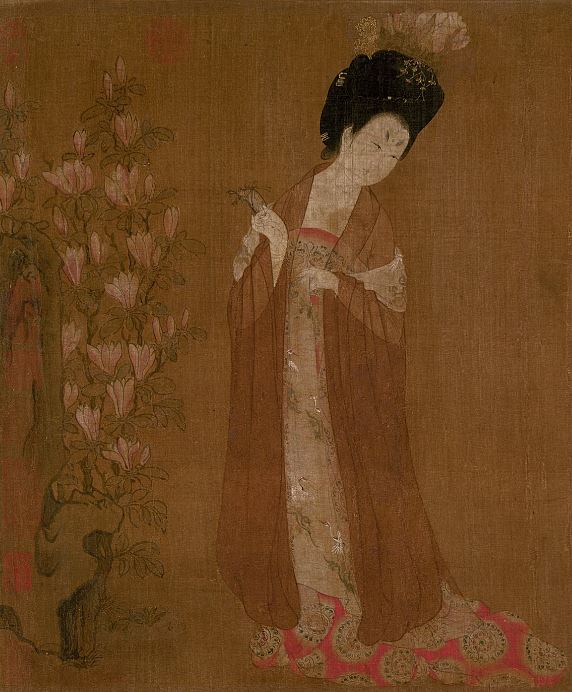
Although their robes conceal the contours of their bodies, the women’s figures are not shapeless. Through the gauze, we can see the gently curved lines used to outline their pale arms.
There isn’t a single straight line or sharp edge on these women; from their rounded faces to their sloping shoulders, the delicate curve of their forearms and their dainty fingertips, they’re painted in smooth flowing lines that emphasize their soft femininity and gentle elegance.
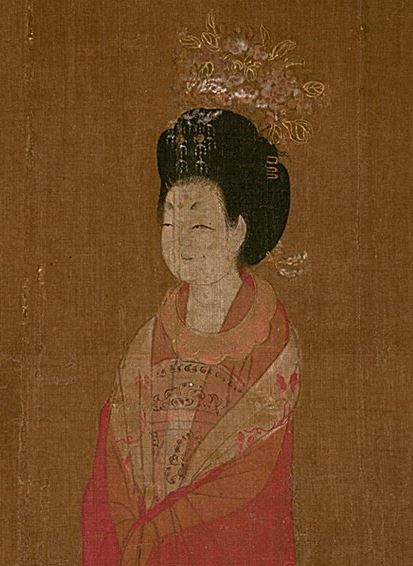
Delicate ornaments and flowers adorn their hair, while their makeup is meticulously done to reflect a faithful representation of women’s fashion during the Tang Dynasty. Their eyebrows resemble butterfly wings, while a fine hairstyle frames their faces.
The painting also allows viewers a glimpse at the amusements of Tang Dynasty noblewomen, such as admiring flowers, playing with small dogs, or watching the movement of cranes.
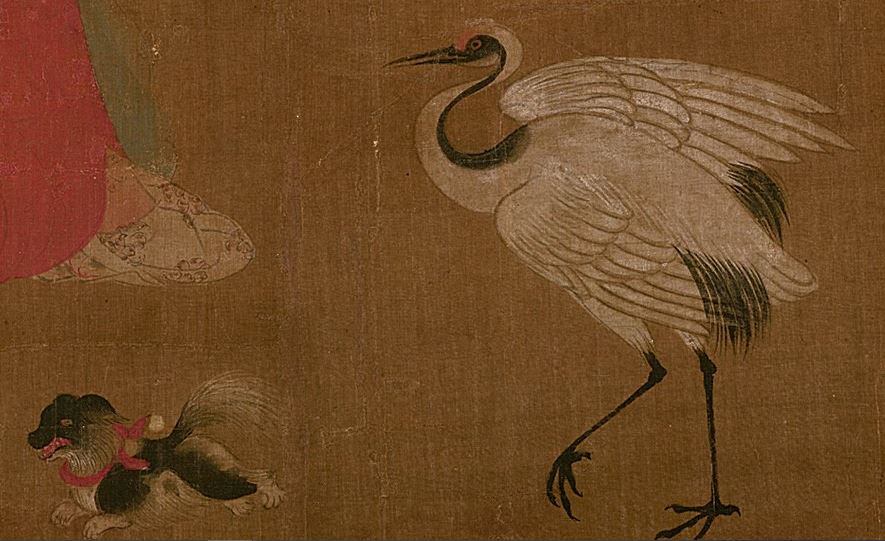
The silky fur of the dogs is depicted by brisk, fine lines, allowing the viewer to see the wind stirring through their long hairs as they frolic near their mistresses.
The wispy feathers on the crane are also drawn with lines, though of a different consistency. One can tell that the crane has powerful wings, and its leg raised mid-step conveys a sense of motion, further bringing the animal to life.
Over a thousand years since the creation of these paintings, the legacy left by the ancient masters continues to inspire and influence painters today. Contemporary artists have innovatively applied the line art techniques displayed in traditional Chinese paintings to produce outstanding artworks that fuse the past and the present.
6.
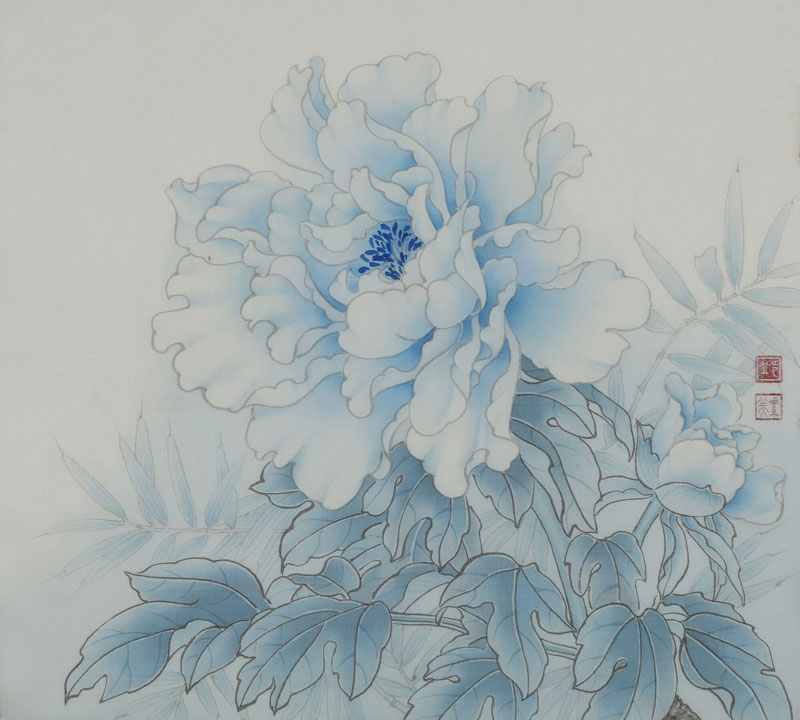
Title: Ethereal Peony, 2023
邱素美《清雅》
Painter: Chiu Su-mei
Medium: ink and color on silk
Size: 30h x 30w cm
Hailed as “the king of flowers,” the peony is a symbol of nobility and beauty, often associated with empresses. While peonies are commonly painted in vivid shades of pink for a touch of flamboyance, in her painting Ethereal Peony, Chiu Su-mei chooses to use a cool-toned color palette to give the peony a much more reserved—yet no less elegant—touch. The entire painting exudes an exquisite elegance and serenity that reminds one of Song Dynasty porcelain.
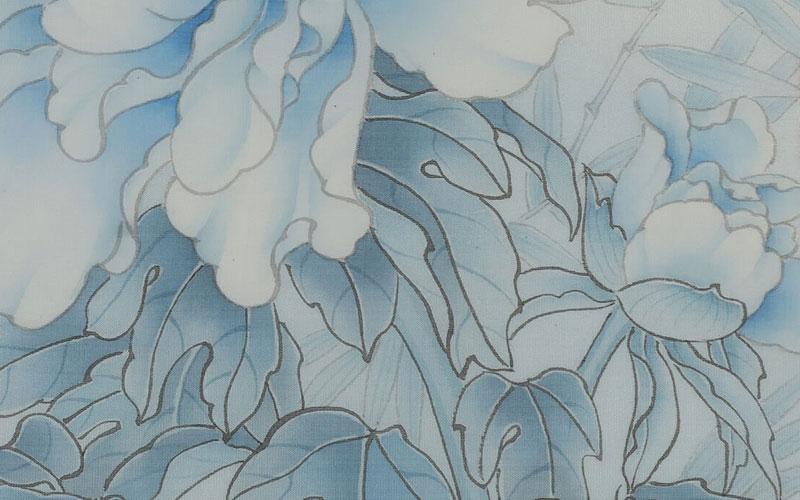
Chiu’s painting may look relatively simple at first glance, but that’s only because its complexity is hidden in the meticulous details. With the baimiao technique, Chiu employs smooth fine lines to paint the peony’s soft petals. The flower’s leaves, less tender than the petals, are outlined slightly more thickly, though fainter lines are used to depict their veins.
Similarly, faint lines are used to paint the leaves in the background, yet in no less detail. An observant viewer can see that the veins on those leaves have not been left out and are painted in even fainter lines.
7.
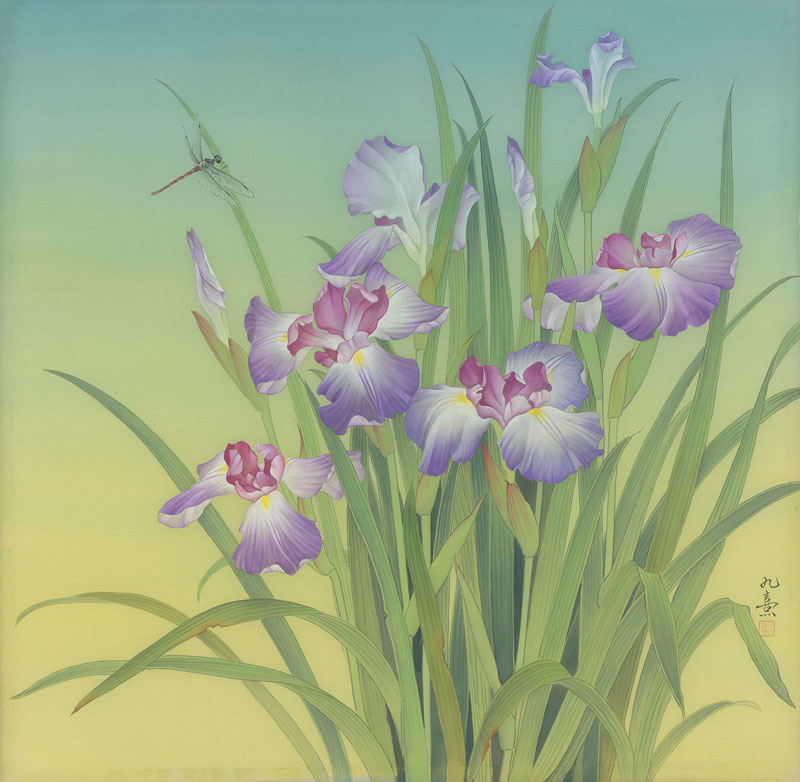
Title: Fragrant Orchids, 2021
陳九熹《紫豔香風》
Painter: Chen Jiu-xi
Medium: ink and color on silk
Size: 50h x 50w cm
One cannot help but be stunned by the exquisitely stunning mastery of fine lines in Chen Jiu-xi’s painting Fragrant Orchids. With deft strokes, Chen brings out the elegance and velvety texture of the flower petals, while with his long, simple strokes, he offers a realistic rendering of the long leaves.
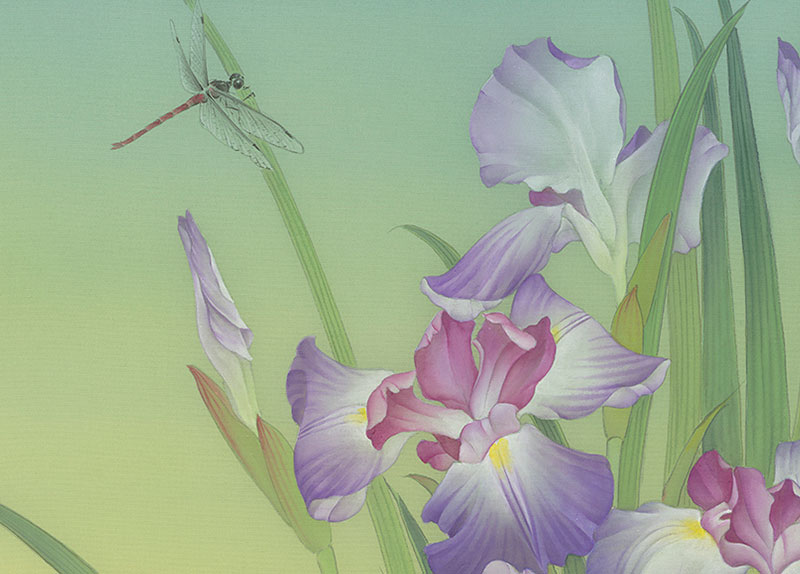
Yet the most impressive aspect is the breathtaking manner in which Chen meticulously paints the veins of the dragonfly’s wing. The gossamer thin lines give the dragonfly such a life-like quality that one almost wonders if it is, in fact, a real dragonfly that mistook the painting for a real plant and landed on its leaf to rest.
8.
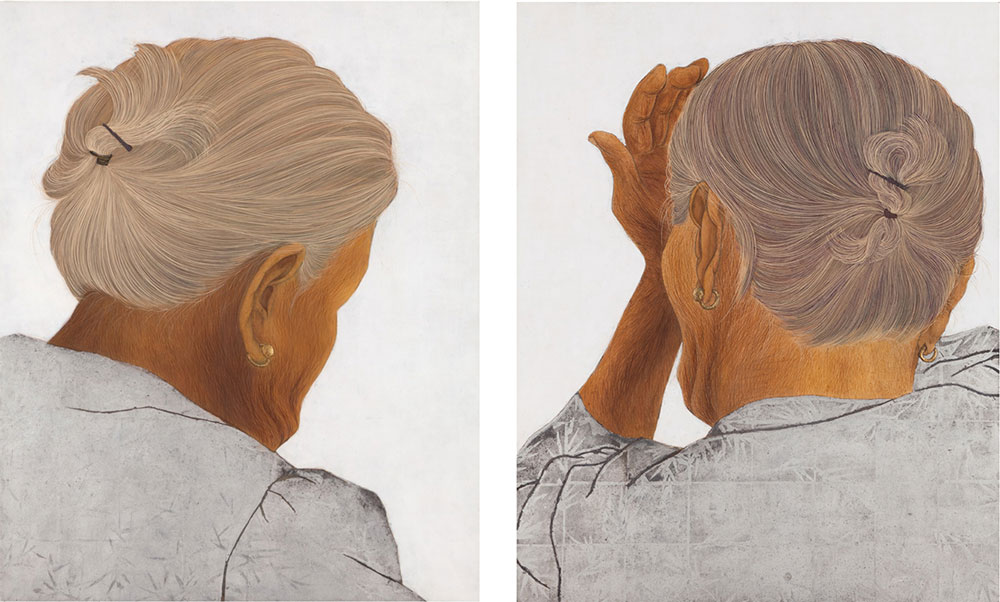
Title: A View of Grandmother’s Back, 2004
鍾舜文《背影》
Painter: Chun Shun-wen
Medium: Mineral Pigment on Silver Foil, Gold Foil, Korea Chun Paper
Size: 122 cm x 98 cm
There’s an authenticity to Taiwanese painter Chung Shun-wen’s paintings that conveys a keen attentiveness to the details of day-to-day life. Simple gestures become frozen in time on Chung’s canvas.
In A View of Grandmother’s Back, Chung captures the back-view portrait of her grandmother. Perhaps it’s the hyper-realistic rendering of every detail that makes this painting so heartwarming. One can imagine Chung gazing lovingly at her grandmother, using astonishingly fine lines to paint each strand of her hair and the creases of age on her roughened skin.
Each strand is as fine as gossamer, executed in smooth, steady strokes. The artist pays close attention to depicting the direction of the hairs when twisted in a bun. Chung paints each individual hair at the nape of her grandmother’s neck and at the edge of her hairline.
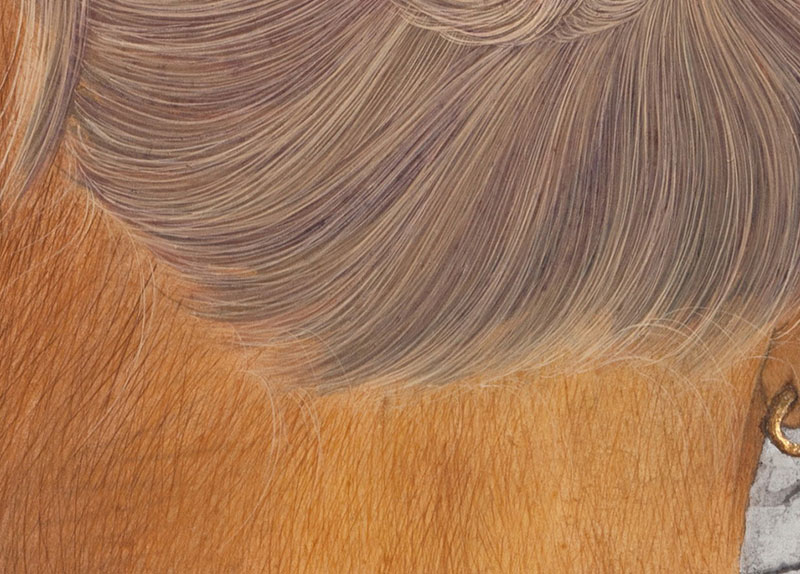
Longer strokes are used to paint the grandmother’s wrinkles, and in a stunning display of artistry, Chung uses short, extremely precise lines to paint the natural line patterns of human skin. With thicker lines, she paints the creases and stitching of her grandmother’s shirt. These much simpler lines—enough to bring out the realistic appearance of a shirt—contrast the lines used to paint the hair and skin, making those lines seem even more impressive.
9.
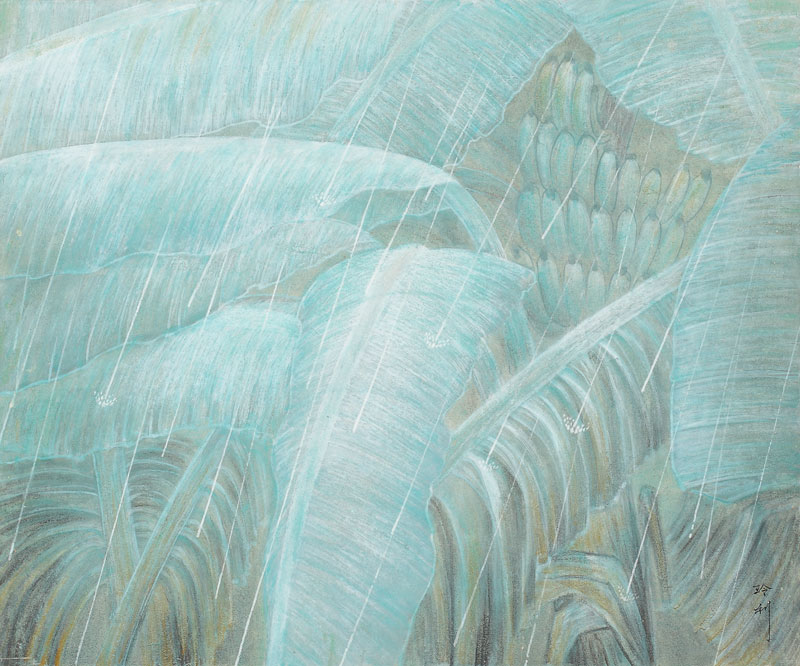
Title: Summer Rain, 2001
劉玲利《夏雨》
Painter: Liu Lingli
Medium: Mineral pigment on linen canvas coated in linen paper
Size: 72.5 cm x 60 cm
Can you hear the torrent of summer rain hitting the banana leaves when you look at Taiwanese artist Liu Lingli’s painting Summer Rain? The long leaves are bent over as if attempting to shield the fruits peeking out from underneath, and despite the rain, there’s something cozy about this painting.
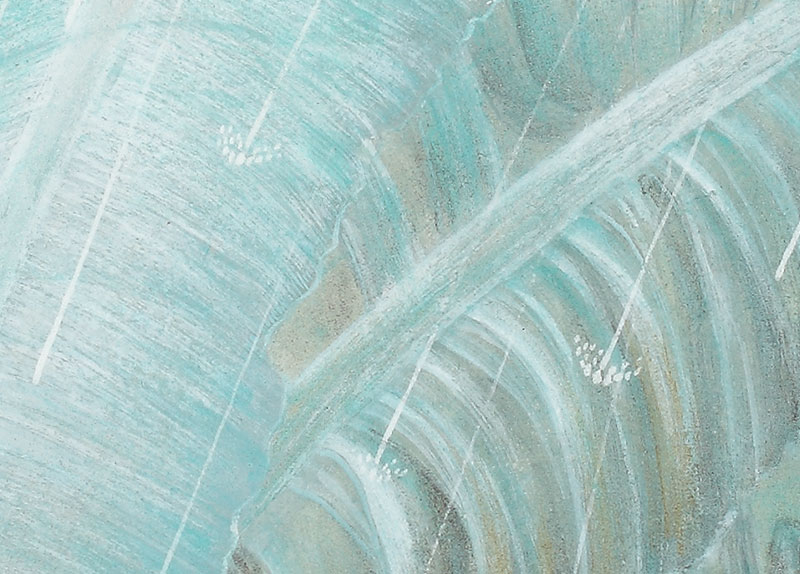
Liu paints the raindrops dashing down in swift, thin strokes, conveying to the viewer that this isn’t a light spring drizzle. To further communicate the force of the rain, Liu paints the tiny spray of water caused by the raindrop when it hits a leaf.
10.
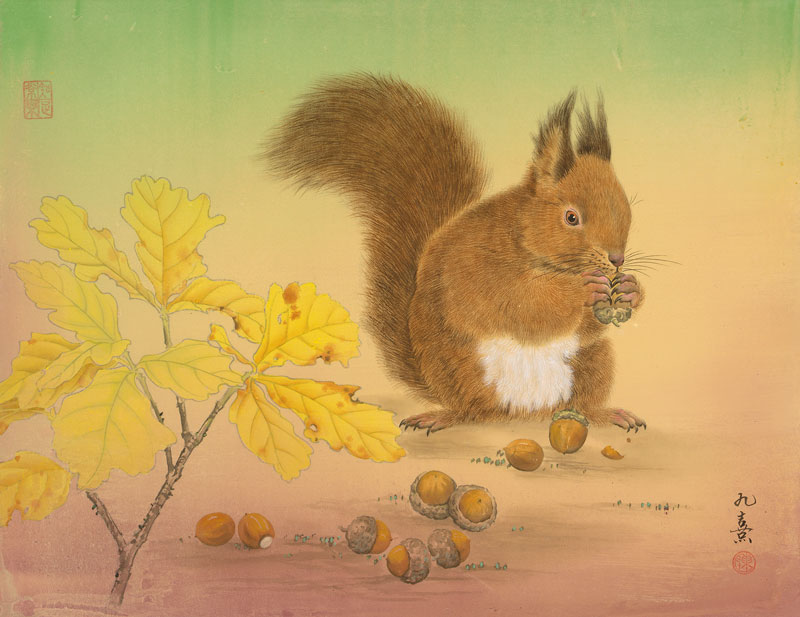
Title: Plentiful Autumn, 2023
陳九熹《豐禾》
Painter: Chen Jiu-xi
Medium: ink and color on silk
Size: 33 cm x 45 cm
On a fine autumn day, a lone squirrel feasts upon its hoard of acorns. The squirrel’s lifelike quality emerges due to the meticulous strokes artist Chen Jiu-xi employed to paint its fur. Different types of lines are used to paint the squirrel’s soft underbelly, the long tufts on its ears, and its thick bushy tail. The squirrel’s whiskers are also painted in thin, swift strokes.
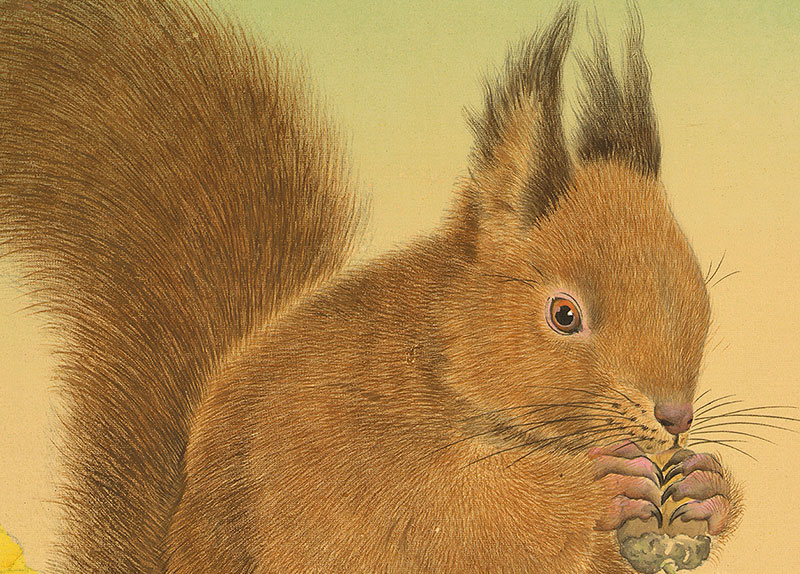
The acorns scattered on the ground and the leafy branch in the foreground are outlined in dark gray ink—not so bold as to be overpowering and make the painting look too artificial—but enough to form a contrast with the furry creature.