

Cultured civilizations have long revered the institution of museums. Carefully curated and filled with precious treasures, these bastions of learning, reflection, and inspiration showcase the evolving story of humanity—through objects drawn from the worlds of history and art.
While the opening of the British Museum in 1753 marked the world’s first national public museum, the art of museum-making dates back much further—to 530 BCE, when Babylonian princess and high priestess Ennigaldi-Nanna became the first known curator of a public collection of antiquities. Over the millennia, landmark institutions have followed—the Louvre, the Victoria and Albert Museum, and the National Museum of Taiwan, to name a few. Today, however, a handful of burgeoning niche institutions are quietly emerging within the landscape of contemporary cultural consciousness.
These private, independent museums are sometimes found far from major urban centers, trading crowds and bustle for remote wilderness and tranquil landscapes. For those willing to undertake a cultural pilgrimage, they reveal avant-garde architecture intrinsically connected to its natural surroundings—structures as artistically compelling as the artifacts they house. Meanwhile, dynamic curatorial approaches invite novel, thought-provoking ways to appreciate beauty.
In this article, Magnifissance invites you to join us on a journey to two hidden sanctuaries of culture. Let’s begin in the verdant valley of the Swiss Alps, home to Muzeum Susch, then venture to Japan’s blossom-strewn Shigaraki mountains to discover Miho Museum.

Muzeum Susch: An alpine haven of women’s art
Tucked deep within the lush Engadin valley along the Inn river, and surrounded by looming Alpine peaks, Muzeum Susch rests quietly in the tiny Swiss village of Susch. Since opening its doors in January 2019, it has become a veritable haven of exceptional works by modern and contemporary female artists.
The museum is the vision of Grażyna Kulczyk, a Polish entrepreneur and devoted patron of contemporary art. She stumbled upon the site by chance a decade ago, while on a scenic drive through the rural wilds of Engadin. As she explored the sleepy village—once a waypoint on the ancient pilgrim trail to Santiago de Compostela—she was captivated by its tranquil beauty. There, nestled in the heart of the mountains, she discovered the crumbling remains of a 12th-century monastery. Inspired, she envisioned transforming the historic ruins into a cultural retreat—one dedicated to contemporary female voices, a cause especially close to her heart.

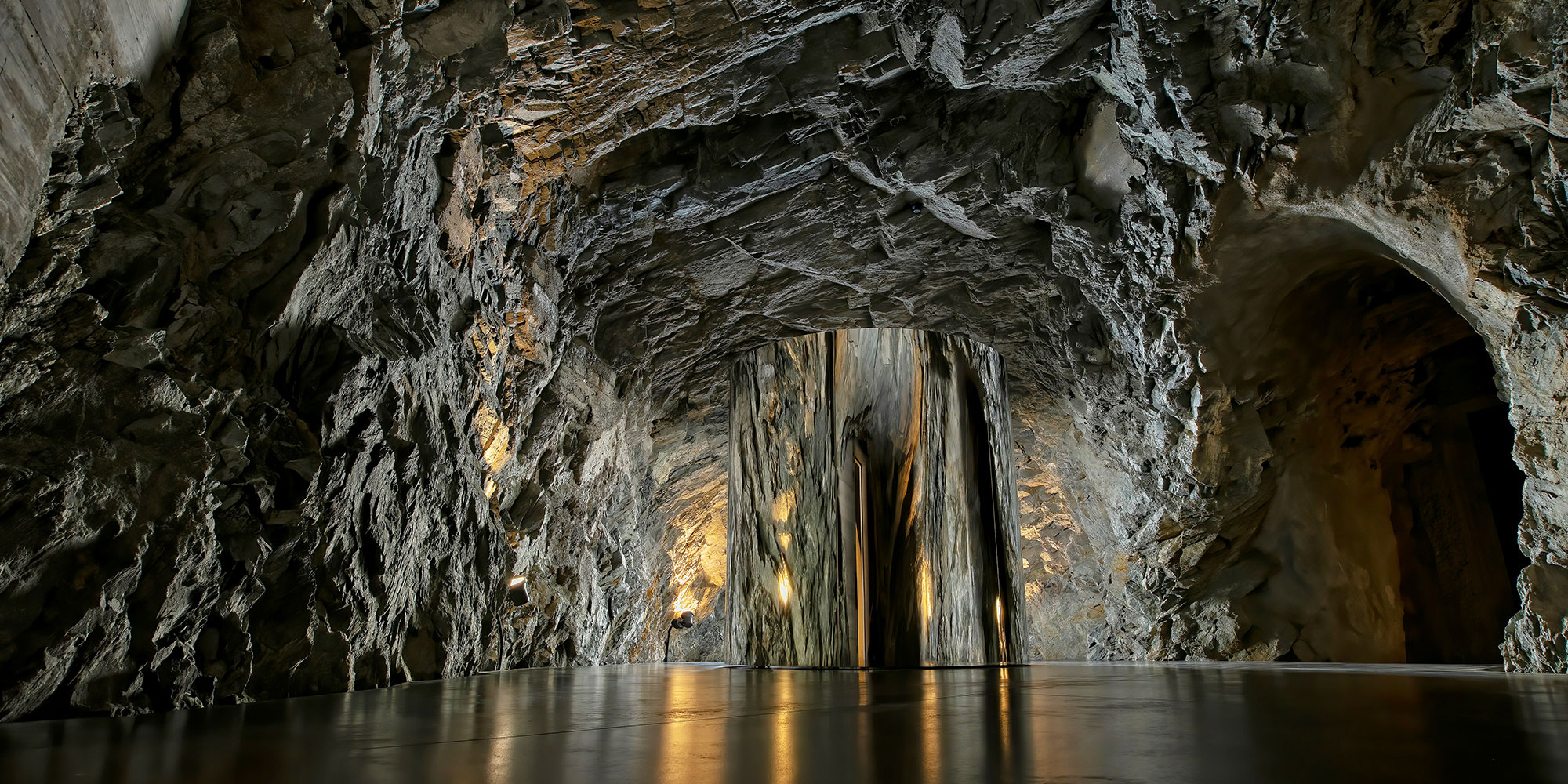
Kulczyk enlisted the talents of Swiss architects Chasper Schmidlin and Lukas Voellmy to realise her vision. They sensitively restored and evolved the pre-existing monastery structures with deference to their distinctive character, while creating stunning exhibition spaces within buildings that had undergone numerous renovations over the centuries—including a stint as a brewery in the 19th century. The most thrilling aspects of the architecture, however, are the bold new areas carved directly out of the mountainside itself, resulting in the excavation of approximately 9,000 tonnes of rock.
A potent contemplation between past and present, human creativity and raw geology, the completed museum fosters a spellbinding dialogue between art and the Swiss mountain landscape it inhabits. Standout features include a natural rock grotto—once used for beer storage—which now houses site-specific artist commissions. Complementing the stone, water is a key design element, symbolizing transformation and interconnectedness. As visitors enter the grotto, often called “the weeping room,” spring water can be seen flowing down the rock walls.
Visitors can also explore a newly constructed subterranean passageway that connects the complex underneath a road running through it. The old brewery building—now housing 1,500 sq m of gallery space—features rooms arranged around the original cooling tower, with a glass extension that illuminates the artwork in natural sunlight. Additionally, the architects intentionally left sections of the excavated stone walls exposed, turning the natural history of the environment into an artistic display in its own right.


Describing itself as a “space for discussion and investigation,” the museum’s experimental curatorial approach is deeply rooted in the practice of a kunsthalle—a venue known for hosting temporary exhibitions rather than boasting a permanent collection.
On her admirable artistic endeavors, Kulczyk has shared: “I hope that Muzeum Susch will educate and inspire people—not only in matters relating to art, to think differently in their approach to everything. I would like it to become a point of reference, both as a site of cultural pilgrimage and as a new model for art and ideas.”
Miho Museum: A reimagined Shangri-La for ancient art
Another far-flung gem, the Miho Museum is nestled on a rugged, misty mountainside deep within a nature preserve in Shigaraki, about an hour’s drive from Kyoto. Opened in November 1997, this private museum began as a wistful dream of Mihoko Koyama (1910–2003), a prominent art collector who envisioned art as a means of celebrating peace, joy, and beauty.

Located in Japan’s Shiga Prefecture, the Miho Museum is an architectural marvel. An artful fusion of Japanese and American ingenuity, it was brought to life through the collaboration of renowned Asian-American architect I.M. Pei and Kibowkan International Inc. The design is inspired by Tao Yuanming’s timeless fable, The Peach Blossom Spring.
In the story, a fisherman follows a mountain river to a blossoming peach village, beyond which he unwittingly discovers an ethereal place where people live in perfect harmony with nature. Similarly, upon witnessing the beautiful site of the future museum for the first time, Pei was so moved that he declared, “This is Shangri-La.”


Like the fisherman, visitors must be dedicated to their journey, as the museum can only be accessed by traversing a cherry tree-lined mountain slope, before entering a mysterious arched tunnel that winds its way around the rock.
On the other side, sunlight floods the senses, and the first glimpse of the geometric glass-and-steel roof of the museum emerges—a nod to I.M. Pei’s iconic glass pyramid topping the Louvre in Paris. Finally, a bridge, half-suspended above the lush mountain peaks, must be crossed before reaching the entrance, screened by a thick veranda of pine trees. Only then can the remarkable building, a vision set amidst a whirlwind of blossoming petals, be fully appreciated.
To preserve the extravagant beauty of the mountain landscape, 80 percent of this ultra-contemporary museum is embedded beneath the surface of the terrain. Pei described this decision as “a very conscious attempt to make the silhouette of the building comfortable in the natural landscape… I am certain that those who come here will understand that I consciously designed the museum to be assimilated into nature.”

The space-frame roof, simultaneously minimalist and innovative, features a triangular design that floods the interior with natural light, blurring the boundary between inside and out. Panoramic views of the surrounding mountains were integral to the architectural vision, with galleries carefully positioned to frame the landscape as dramatically as the artworks themselves. Warm, textured materials strike a harmonious balance with the structure’s transparency, including tinted concrete and honey-hued Magny Doré limestone.
Over the course of more than 40 years, Miho Koyama personally assembled an eclectic yet much-admired collection of Japanese artisanry—including calligraphy, ceramics, lacquerware, and tea ceremony utensils—which formed the foundation of the museum’s initial displays. Since then, the Miho collection has expanded to include around 3,000 works of art from Japan and beyond, featuring antiquities from Egypt, China, Greece, Rome, and regions across Southern and Western Asia.

pale ochre limestone, with light pouring in through the glass roof above.
At any given time, between 250 and 300 objects are on display. Iconic pieces include a majestic 2nd-century Standing Buddha from Gandhara, in present-day Pakistan; a rare yohen tenmoku tea bowl—one of only four in the world—from China’s Song Dynasty (11th–12th century); and more.
A testament to her enduring legacy, the Miho Museum continues to uphold the values Koyama championed during her lifetime—namely, to make the world a more beautiful, peaceful, and joyful place through art.