


Japanese crafts tend to inspire a certain air of reverence in the viewer. These beautifully designed pieces seem to belong in a rarefied space where precision is just as crucial as artistry, where ingenuity and immense patience are prerequisites.
Indeed, when we stop to appreciate a finely made Japanese piece of art, we’re able to contemplate the result of hundreds of hours of manual work, decades of experience and mastery, and centuries of techniques carefully honed and passed on.
This is especially true when it comes to Japanese lacquerware, notably the lacquerware crafted in Wajima, a city that sits on the northern tip of the Noto Peninsula—lacquerware that’s esteemed not only in Japan but also throughout the world.

Today, only a handful of workshops produce the Wajima lacquerware, or Wajima-nuri as it’s known in Japanese. Among these is the House of Shioyasu, a family-run business established in 1858. While in the beginning it specialized in a single aspect of lacquerware creation, in 1904, Masanojo Shioyasu, the third-generation owner, expanded the firm, involving it in all stages of production.
Shinichi Shioyasu now runs the Shioyasu Urushi Ware Company as the fourth-generation owner. “This approach of my grandfather, Masanojo, went well and led to his gaining independence as a Nushiya,” Shioyasu says. “About 60 years ago, after World War II, my father, Seiji Shioyasu, built the present-day shop and workshop. While the company has moved twice, it has stayed within the city of Wajima.”
Mysterious origins
Theories abound as to the origins of Wajima-nuri. One is that it was taught by a Buddhist priest from Negoroji Temple in Iwade, Wakayama prefecture. However, precisely how, where, and when the craft began remains largely unknown.
Another important place in the history of the craft is Sojiji Temple, located close to Wajima, where disciples from across the country gathered to study Zen Buddhism. “I believe that after their apprenticeship the monks took Wajima-nuri trays and bowls to their home temples throughout Japan, which brought awareness of this lacquerware,” Shioyasu says.
The common thread among these theories—some folklore and others more scholarly—is that Wajima lacquerware is derived from Nego lacquerware, which for centuries was used for daily household tasks due to its durability.
Evolved over time, Wajima-nuri was officially registered as a “traditional craft” in 1975. It was eventually designated as an “Important Intangible Cultural Property” by the Japanese Agency for Cultural Affairs, earning more artistic and decorative associations.

Patient process and unique ingredients
While the enigma surrounding the origins of Wajima-nuri adds a layer of fascination to the art, its distinctiveness is grounded mainly on two aspects: the unique material and its remarkable durability.
“Lacquer is this beautiful natural product the Earth has given us,” Shioyasu says. “The fine diatomaceous earth powder [found only in Wajima] mixed in with the lacquer used as an undercoat is kind of like stoneware dust. It makes the lacquerware strong so that even if you drop it, it won’t break.”

Requiring upwards of 130 steps, the process of making Wajima-nuri—from wood turning, lacquering, and decorating—is long and meticulous. As in most Japanese crafts, immense discipline is required to master it.
It takes at least 10 years and the completion of 120 courses to learn how to produce it. The process of learning the concepts and observing masters lasts at least three years, and only after that is an aspiring lacquerer able to do hands-on training and practice. Among the most crucial skills Wajima lacquerers need to cultivate is building their own tools. Since bowls come in different shapes and sizes, brushes and other tools must be customized.

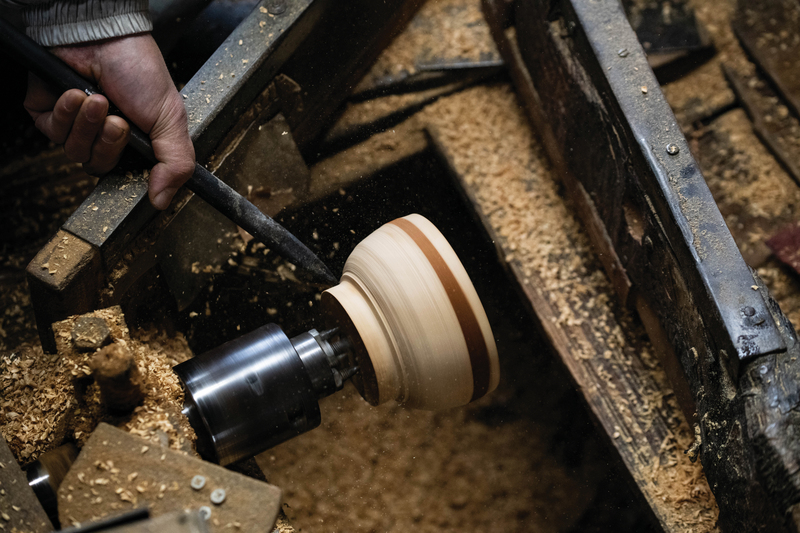
The process begins with forming the wooden base, made either from Japanese Zelkova trees or from Cherry birch trees that are cut and left for up to three years until they are completely dried. Once fully dry, they’re trimmed down and carved.
Most of the undercoating process is focused on ensuring the durability Wajima lacquerware is widely known for. “It’s unique in that we add a layer of cloth and mix powdered diatomaceous earth into the undercoat lacquer, which makes it more durable,” Shioyasu says.
“This strong base also makes it possible to re-lacquer pieces when they become damaged. The fact that the pieces can be repaired when necessary is also an important quality. This allows them to be used for a very long time.”
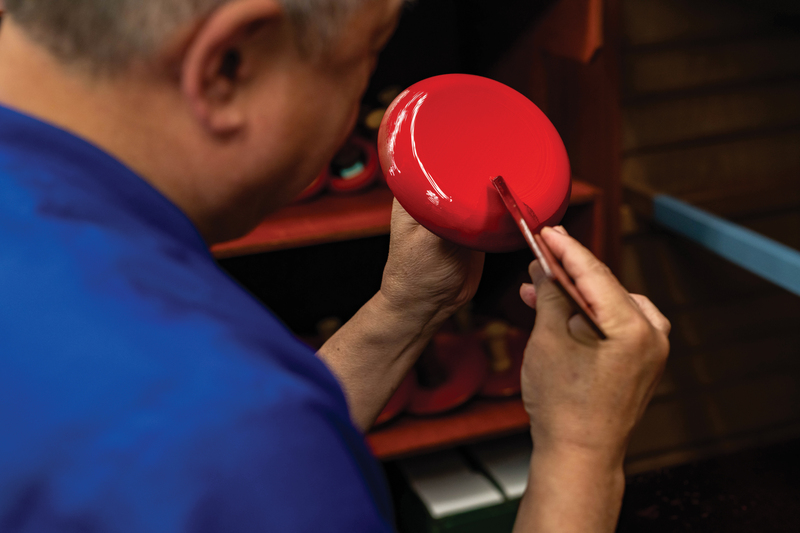
The final and possibly most critical stage of Wajima-nuri is the application of the topcoat, which ultimately dictates the overall quality of the lacquerware. Shioyasu notes that the paint used on lacquerware comes from the lacquer tree, which can’t be combined with any synthetic material, and therefore handling it can be a very delicate process.
As the number of lacquer trees decreases and workers who gather the lacquer sap from the trees get older, scarcity has reduced lacquerware production dramatically through the years, thereby making Wajima-nuri even more valuable.
The delicacy of applying the topcoat is also essential. This step must be done in a dust-free environment, as a single speck of dust can damage the appearance of the lacquerware and waste years of work.
“Applying the topcoat requires a great amount of patience and stamina; it involves sitting with a good posture for at least eight hours,” Shioyasu says. “An often demanding, repetitive, and isolating experience, the artisan often gets lost in the work.”
“Aesthetically speaking, the special skills of the craftsmen produce a final product that is extremely smooth without the slightest irregularity. Because the lacquering process is divided into three stages—the base, the middle, and the final layer—the division of labour has made keeping this highly skilled process possible.”
The last step, ornamenting the lacquerware, is done largely by two methods: chinkin, a form of carving filled with gold or silver; and maki-e, the application of gold or silver powders onto a design.

“What makes it even more special is that all these steps are done right here in Wajima,” Shioyasu says. “All the craftsmen and workshops necessary to make lacquerware are available here; the techniques and the infrastructure are all here. This is not true of other regions that produce lacquerware.”
Looking to the future
While Wajima-nuri flourished for many centuries, with many of its master craftsmen getting older and the supply of local raw materials like Noto cypress, Zelkova, Urushi trees, and Wajima Jinoko powder gradually decreasing, it’s now seen as an endangered art. As such, the few existing workshops are compelled to preserve the craft and ensure that it continues for centuries to come.
The Shioyasu family is one of them. “We have such a long history in this craft, and we feel duty-bound to try to preserve the techniques of the past and to be as ambitious as our forebears in developing new markets and products, while still endeavouring to keep some of the best items from the past on our books,” Shioyasu says.
He feels, however, that it’s equally important to embrace innovation and be open to adapting the craft to products other than traditional bowls and dishes. “We’ve changed a few things in the finishing process. We’re also exploring different shapes and new realms. I want to look at new possibilities for lacquerware,” Shioyasu says.
His workshop does precisely this with its recent collaboration with British furniture designer Max Lamb. “Keeping an eye on what’s coming next is of the utmost importance, not only for the Shioyasu Urushi Ware Company but also for Wajima-nuri,” Shioyasu says.
“We need to watch out for the future of this craft. We can ensure this both by passing on traditions and by being innovative.”