

When Georges Vuitton devised the interlocking monogram in 1896, it was not born out of an artistic epiphany, but rather a hyper-practical necessity. It was a copyright shield, a graphic statement meant to deter the counterfeiters copying his father’s flat-topped travel trunks. Over the subsequent 130 years, that protective seal transformed into something else entirely, the global symbol of the spirit of travel. Yet, a signature that becomes ubiquitous faces a modern challenge. In an era saturated with immediate visual stimulation, the true test of luxury is how it restores a sense of discovery to its most recognizable emblem.

The answer, unveiled for 2026, is an elegant return to the loom. To mark the monogram’s milestone anniversary, Louis Vuitton has stepped away from the familiar canvas coatings of the 20th century to introduce Monogram Emblème. It is a textured, jacquard canvas that translates a visual icon into a tactile experience.

The fabric looks backward to step forward, studying the unvarnished cotton and linen canvases that enveloped the original 19th-century trunks. The new material blends global organic textile standard (GOTS) certified cotton with premium linen fibers. The result is a surface of remarkable resilience and water-repellency that simultaneously possesses a rich, irregular hand-feel.
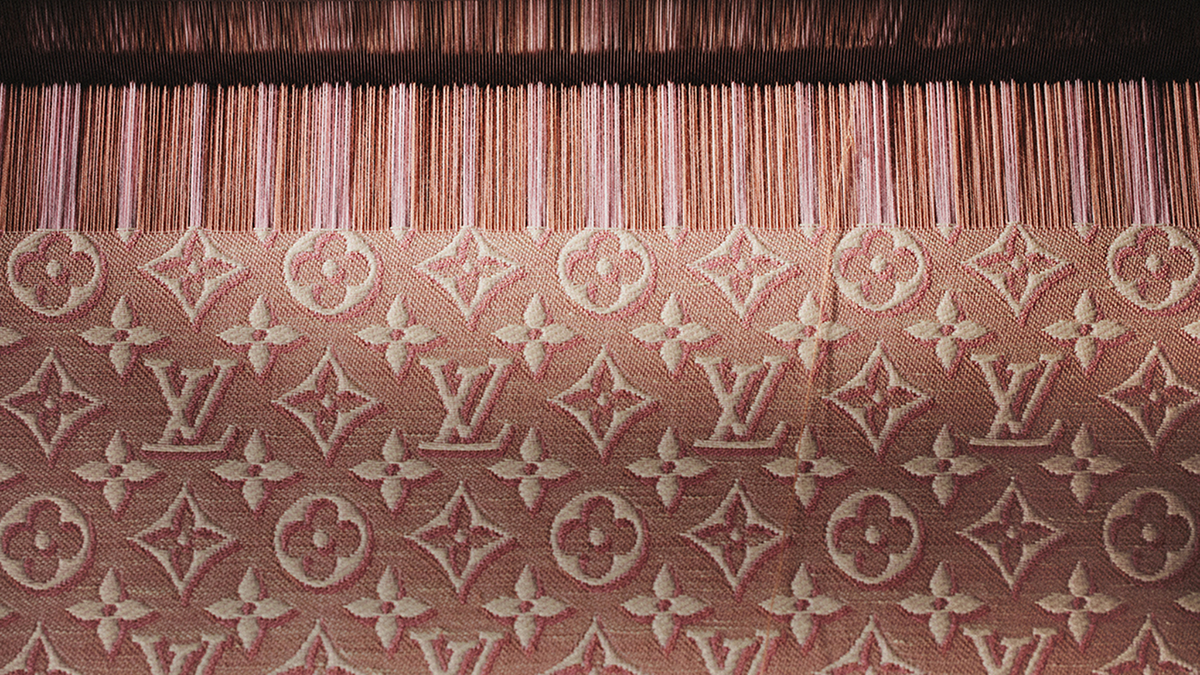
The real mastery, however, lies within the weave itself. Utilizing an intricate jacquard construction, the pattern is meticulously built using five separately colored threads. Rather than being printed onto a surface, the monogram is literally born from the structural framework of the cloth. This technique yields a denser, multi-dimensional relief that mimics the depth of hand-embroidery. As light passes across the surface, the five distinct threads create subtle, shifting variations in shadow and tone.


For its debut in the Pre-Fall collection, the palette draws directly from the Vuittonnier, the house’s historical register of signature shades. The initial launch introduces Peuplier, a warm, sandy hue that honors the poplar wood hidden within the skeletal framework of archival luggage, and Rose Ruban, a soft, romantic tone drawn from the interior ribbon work of vintage trunks. Later in the year, the family expands to include Monogram Bleu, a deep shade pulled from a 1930s color log, and Vert Jura, a rich green inspired by the forests and flora of the alpine region where Louis Vuitton himself spent his youth.

Rather than isolating this textile innovation to a limited capsule, the maison is introducing it across its most enduring silhouettes. The structured lines of the Alma, the generous proportions of the Neverfull, the classic utility of the Speedy and Noé, the expansive Keepall, and the architectural Side Trunk will all adopt the new jacquard posture.

Crucially, the introduction of Monogram Emblème arrives alongside a renewed emphasis on the brand’s bespoke Care & Repair program. Operating through a global network of 11 dedicated repair workshops, highly trained artisans employ traditional hand-stitching and historical techniques to restore worn pieces to their peak condition.

By marrying the tactile character of the 19th-century trunk with the technical virtuosity of the modern jacquard loom, the maison has crafted a material, in an era so accustomed to chasing the fleeting thrill of the new, that feels as though it has always existed.