


“Venetian velvets are beautiful, perfect, and technically the best.”
—Rodolfo Bevilacqua
From the 13th to the 18th centuries, Venetian velvet symbolized power, wealth, and taste. Paintings by Venetian artists, such as Titian and Tintoretto, depicted cardinals wearing crimson velvet robes and noblewomen in velvet-encased high heels.
At the industry’s height in the 16th century, there were 6,000 wooden looms working to meet the demand of Renaissance nobility. Today, Tessitura Luigi Bevilacqua is the last traditional atelier to craft the rich textile on 18th-century looms.
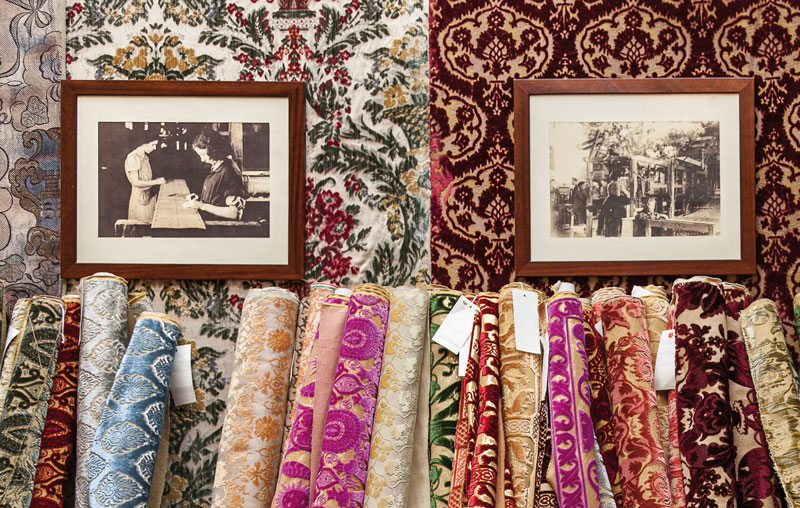
The atelier has produced velvet for the Vatican and the White House, among other prestigious venues. Its rare fabric has adorned the regal dress of kings, popes, and aristocrats, alongside the clothing of celebrities like Elizabeth Taylor and Farrah Fawcett.
Tessitura Luigi Bevilacqua was officially founded by Luigi Bevilacqua in 1875, yet its textile tradition can be traced back to 1499.
In an interview with Rodolfo Bevilacqua, the great-grandson of Luigi Bevilacqua, we discuss how his family has preserved the trade secrets of velvet-making as well as the legacy of Venice itself.

Visiting the atelier
Walking through short, narrow medieval Venetian streets, you reach a typical two-storey building. The Luigi Bevilacqua atelier is on the ground floor.
“When you enter the door of Bevilacqua, you are stepping into the past,” Rodolfo Bevilacqua says.
Stacked from floor to ceiling are 3,500 designs ranging from the 15th to 20th centuries. Twenty wooden 18th-century looms with dangling ropes move in rhythm with two warps inspired by Leonardo da Vinci’s sketches.
“The looms are like music,” Bevilacqua says.
In the early 19th century, Napoleon closed Venice’s weaving mills to protect the French textile industry. Decades later, Luigi Bevilacqua salvaged the old looms and designs—the same ones in the workshop today—to preserve the precious Venetian legacy.
“We have a very rich historical archive, from the Byzantine to the Art Deco style. Customers usually pick from the archives, but we also have no problem producing new designs in a classical or modern style,” Bevilacqua says.
All other Venetian ateliers gave up manufacturing handmade velvet because the process was too complex and slow, but his family understands its importance.
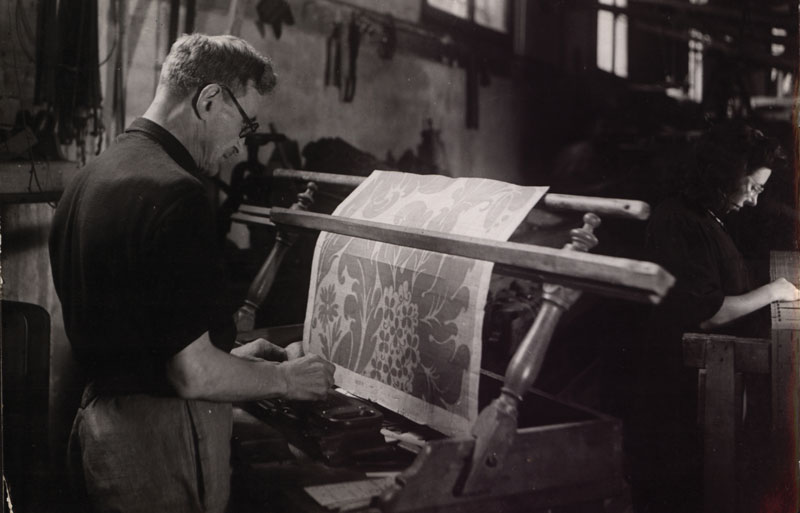
“Weaving is an art. Art cannot be quick,” Bevilacqua says. “We’re making a piece of art more than a fabric—we’re preserving our tradition.”
This artistic spirit and devotion are epitomized in the atelier’s recently finished project for the Royal Palace of Dresden in Germany.
At the start of the project, the palace gave the atelier small fragments of ancient velvet that once adorned the castle’s walls. The Bevilacqua atelier then crafted two 17th-century looms to produce velvet that would be a perfect historical match.
The master weavers subsequently spent five years crafting 750 metres of handmade crimson velvet at a rate of 25 cm per day.
“When we went to see the rooms in the palace [at the end], it was really amazing,” Bevilacqua says. “It was a huge project and brought a lot of satisfaction.”

The world’s most luxurious fabric
The signature textile of the Bevilacqua atelier is soprarizzo velvet, a fabric so prized that, during the Renaissance, Venetian weavers were prohibited from leaving the city to avoid leaking the secret.
This velvet consists of two layers or levels of fabric that can only be woven by hand. The bottom layer absorbs light while the top layer reflects it, like shimmering light over a glassy lake.
Weaving this rare fabric takes patience—15,000 threads of silk need to be attached one by one before beginning production.
The fate of this remarkable craft rests upon the shoulders of seven master weavers, who spin just 20 cm to 80 cm of velvet daily.
“Venetian velvets are beautiful, perfect, and technically the best,” Bevilacqua says.
The Bevilacqua atelier continues to pass down these prized textile techniques in the traditional way.
“Our young weavers come from the School of Art in Venice, but they really learn the job here. There’s no school that can teach you how to weave soprarizzo velvet. We still work as they did in the past. The skills were transmitted from father to son,” Bevilacqua says.
“The next generation of our family also understands that we’re preserving history. We have a great responsibility.”
For centuries, the Venetian Serenissima Republic required rigid standards of excellence for weaving velvet. “That’s why Venetian velvet is so perfect and unique, and this remains in our DNA, in our blood,” Bevilacqua says.