
Few art forms are as distinctive, and alive, as Chinese calligraphy. What originated as the daily clerical labor of ancient bureaucrats has, over the course of millennia, been transmuted into a profound vessel for the soul. While the form demands a lifetime of technical rigor, its ultimate appeal lies not in the ink itself, but in its capacity to map the artist’s spiritual geography. Every spontaneous curve and cadence act as a clandestine transmission of the interior self.
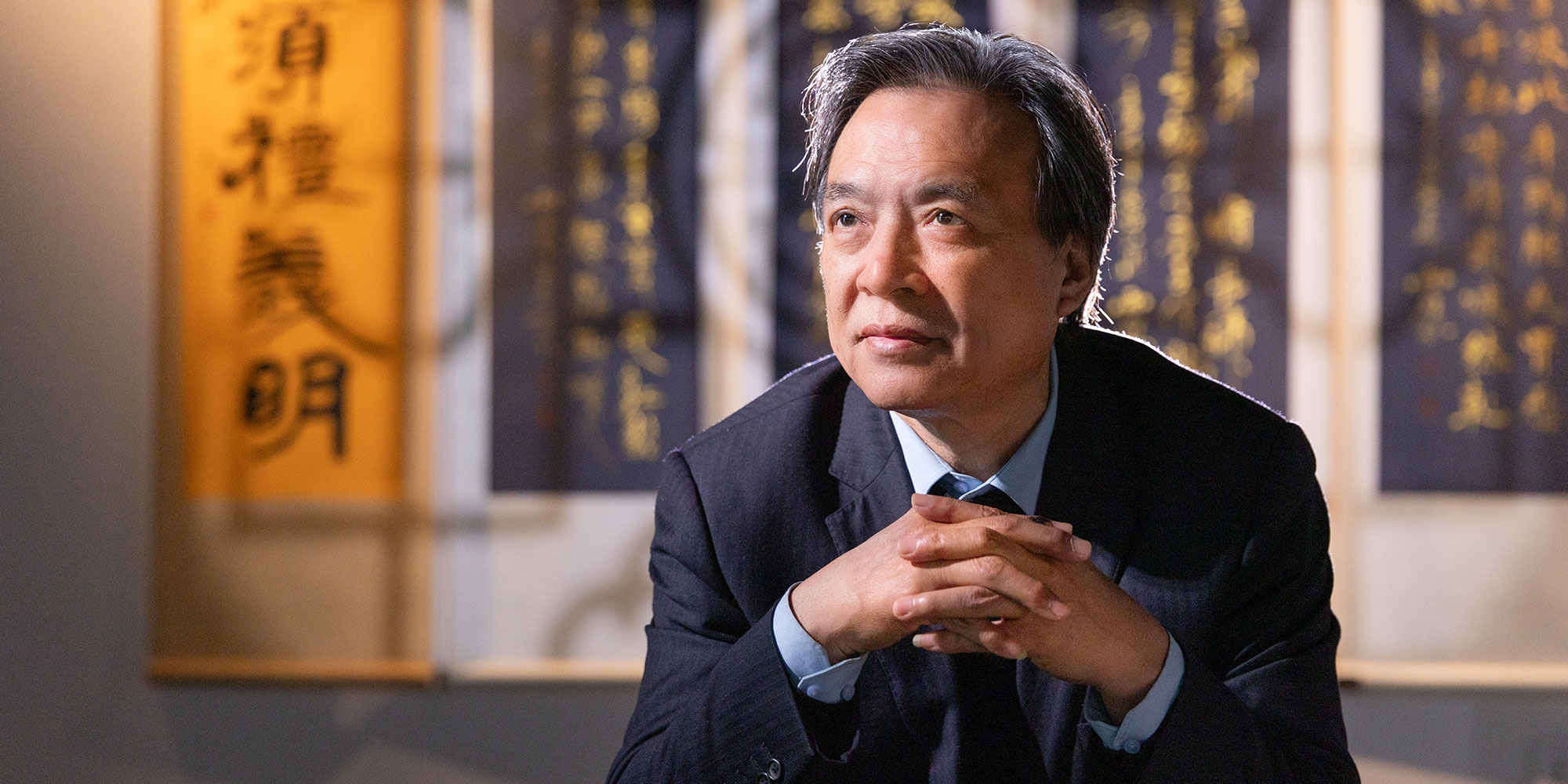
Today, now that ink and rice paper have transitioned from the realm of daily utility into the amber of historical memory, the true calligrapher has become a rare breed. Rarer still is the artist capable of distilling archaic weight into modern relevance. Wang Deshuo is that rare voyager between epochs, creating a style that is at once a tribute to the ancients as well as a manifesto for the present.
Where the majority of contemporary practitioners are drawn to the unrestrained Cursive Script (Xing Cao), Wang has devoted his oeuvre to the marginal, some might say willfully unfashionable, niche of Clerical Script (Li Shu).
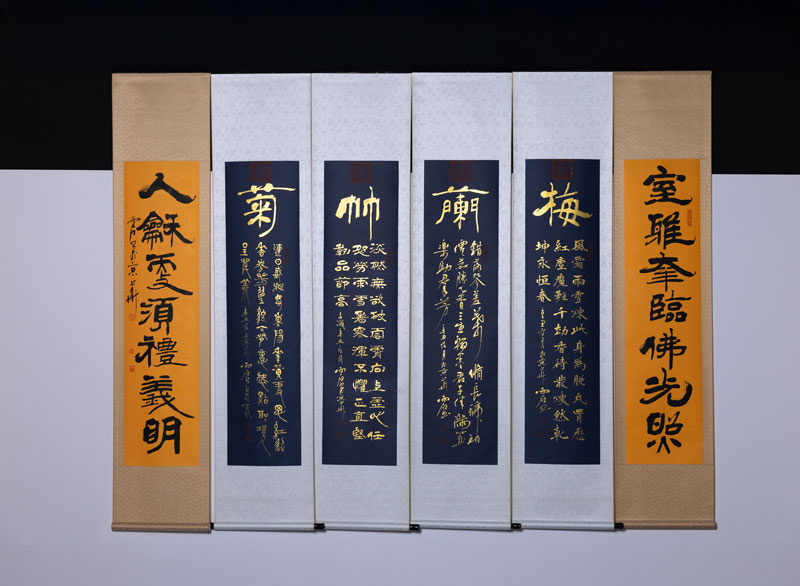
Defined by an archaic simplicity, compositional solidity, and rhythmic pauses, Clerical Script resists spectacle and immediacy. It offers no shortcut to celebrity. Instead, Wang treats the form as a conscious act of creative “retrograde,” a turning away from the frantic cacophony of the modern era toward the restoration of calligraphy’s foundational architecture and inner discipline.
Wang’s devotion to the essential elements of his art has earned him the respect of the industry’s discerning critics, who note: “His Clerical Script is at once unconstrained and magnificent; it possesses a majestic uprightness, standing as resolute and lofty as the peaks of Mount Tai.”
A Living Antiquity
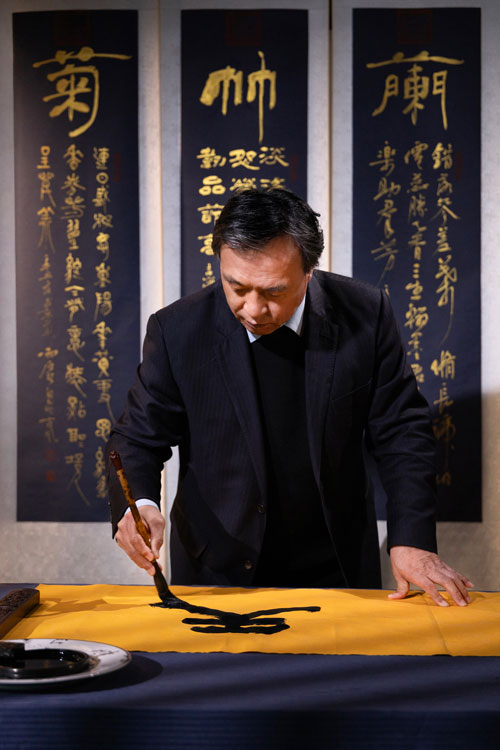
When Wang discusses Clerical Script (Li Shu), he inevitably returns to its Han Dynasty (202 BC –220 AD) provenance. He describes it as an evolution from the earlier Seal Script, whose fastidious symmetry placed unrelenting demands on the hand. Clerical Script, by contrast, introduced the modulation of pressure and the strategic rhythm of the “pause.”
“There is a pervasive fallacy that the Clerical Script is easy, simply because its threshold is accessible,” Wang says. “In truth, no script is more difficult to master.” The challenge lies in a delicate equilibrium: the architecture of the character must achieve stability without succumbing to stasis; its energy must possess a weighted density that remains, nonetheless, animated.
Wang’s mastery was forged through deep immersion in the Han classics, from the lyrical grace of the Cao Quan Stele to the architectural weight of the Zhang Qian Stele. He did not merely study these forms; he internalized their rhythmic fluctuations until they became a subconscious extension of his own physiology.
This process reached a tipping point at a moment of pure serendipity. Wang recalls a breakthrough where his muscle memory, saturated with the square strokes and weighted pauses characteristic of Wei Dynasty stone inscriptions, began to merge spontaneously with his Clerical script. The harmony was instantaneous.
In this creative flash, the unrestrained vitality of Running Script collided with the tectonic grit of the Wei Dynasty steles. What emerged was a singular aesthetic: a style where the structural “bone” of the stone supports the instinctive “soul” of the ink’s flow.
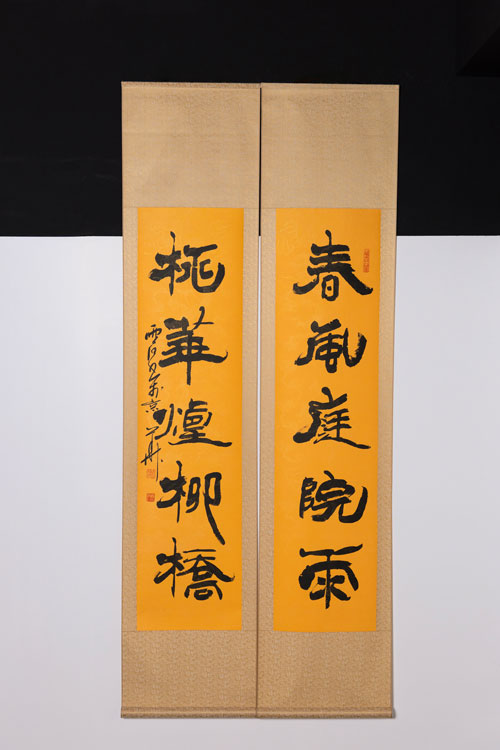
This fusion forms the bedrock of Wang’s oeuvre. His achievement is not one of mimicry, but of restoration. While his characters possess the atavistic soul of the Han, they are galvanized by an idiosyncratic vitality that is unmistakably contemporary.
The Interiority of the Stroke
Wang’s philosophy of refinement aligns with the classical conviction that “calligraphy is the man.” In this view, the scroll is a seismograph of the psyche; beyond the tactile meeting of ink and fibre, it registers the artist’s spiritual frequency: the degree of their tranquility, the breadth of their character, and the clarity of their intent.
For Wang, this discipline is anchored in his practice of Falun Dafa, a meditative discipline guided by the tenets of Truthfulness, Compassion, and Forbearance. The spiritual grounding has winnowed his internal world, leaving behind only the essential, upright core of his character. By viewing the ephemeral pursuit of fame and material gain with a practiced equanimity, he allows a rare sincerity to permeate his brushwork.
He describes the emergence of his mature style not as a technical breakthrough, but as a “revelation,” a shift in his Xinxing, or moral height, that fundamentally recalibrated his artistic vision. While the contemporary avant-garde often drifts into a deliberate state of “chaos and strangeness,” Wang remains an advocate for an aesthetic of “Brightness and Uprightness.” To him, the “clean” and the “upright” are not mere traditionalist tropes; they are the very essence of art.
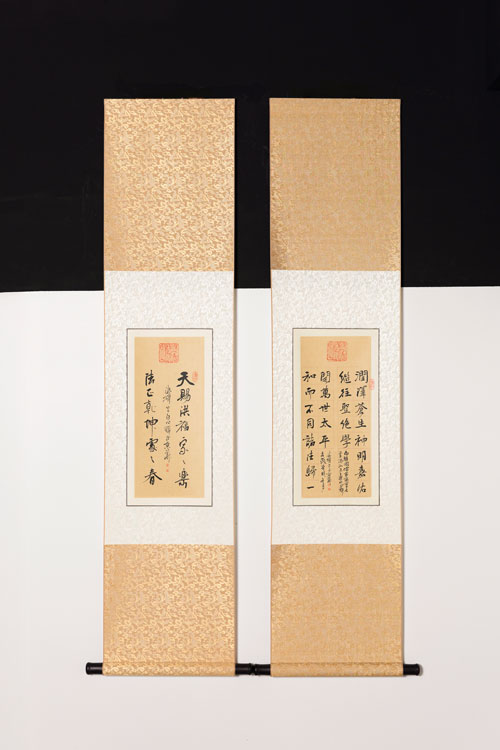
The Vessel of the Tao
Having wielded the brush for over five decades, Wang’s endurance is fueled by a love that borders on the devotional. Among the pantheon of historical masters, he finds a particular kinship with the Yuan Dynasty (1271–1368) scholar Zhao Mengfu (1254–1322). For Wang, Zhao’s significance lies not only in his technical virtuosity, but also in his noble aura, a testament to the conviction that the calligrapher’s spiritual height is what confers an enduring influence upon the ink.
When calligraphy is approached as a sacred undertaking, the stroke generates a resonance that transcends the mundane. This philosophy, treating art as a vessel for the Tao (Wen Yi Zai Dao), has become a rarity in the world of contemporary art that is so often consumed by the ephemeral. Yet, it remains the vital centre of Wang’s vision.
In an era characterized by fragmented attention, his work provides necessary clarity. By honouring ancient rhythms and breathing into them a contemporary spirit, Wang Deshuo allows a new vitality to flourish within the constraints of tradition. This is not merely a revival; it is the stewardship of an ancient culture that still has life in it, perhaps the most resilient intellectual asset of our precarious age.




How Cultivating Her Heart Made Her a Better Dancer
Shen Yun dancer Cherie Zhou relives the soul-searching journey a classical Chinese dancer must go through and her experience portraying challenging character roles.

